
Why Businesses Are Investing in Custom Software Development Instead of Off-the-Shelf Solutions
Every business operates differently. While two companies may serve the same market, their internal processes, customer journeys, operational challenges, and growth strategies are often completely unique.
However, many organizations still rely on generic software designed for a broad audience rather than their specific business requirements.
While off-the-shelf software may offer a quick start, it often creates limitations that become more apparent as businesses grow.
In 2026, companies are increasingly investing in custom software development to gain greater flexibility, improve efficiency, and create technology solutions tailored to their exact needs.
Custom software is no longer considered a luxury. It is becoming a competitive advantage.
What Is Custom Software Development?
Custom software development involves designing and building software specifically for a particular organization or business process.
Unlike pre-built software products, custom solutions are created around business objectives and operational requirements.
Examples include:
- Enterprise management systems
- Customer portals
- Business process automation platforms
- Inventory management systems
- Industry-specific applications
- Internal workflow tools
These solutions are designed to solve specific business challenges while supporting long-term growth.
Why Generic Software Often Falls Short
Many businesses initially choose ready-made software because it is easy to deploy.
However, over time, common challenges begin to emerge:
- Limited customization options
- Unnecessary features
- Licensing costs
- Integration difficulties
- Workflow restrictions
- Scalability concerns
Teams frequently adapt their processes to fit software limitations rather than using software that supports their ideal workflows.
Benefits of Custom Software Development
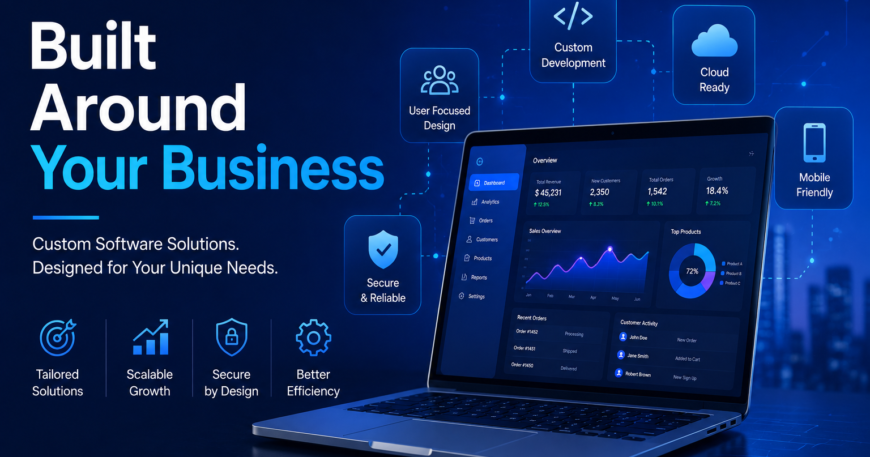
Built Around Your Business
Custom solutions are designed specifically for your workflows and operational goals.
This improves efficiency and user adoption.
Better Scalability
As your business grows, custom software can evolve alongside changing requirements.
New features and integrations can be added without replacing the entire system.
Improved Productivity
Employees spend less time working around software limitations and more time focusing on business objectives.
Enhanced Security
Custom applications can be developed with security requirements tailored to your industry and business environment.
Competitive Advantage
Custom software enables businesses to create unique processes, services, and customer experiences that competitors cannot easily replicate.
Real-World Example
Imagine a logistics company managing shipments through spreadsheets and multiple disconnected applications.
Employees spend hours updating information manually, leading to delays and errors.
After implementing a custom logistics management platform, shipment tracking, reporting, and communication become centralized.
Automation reduces manual work, while management gains real-time visibility into operations.
The result is improved efficiency, lower operational costs, and better customer service.
Industries Benefiting from Custom Software
Healthcare
Patient management systems and operational automation.
Manufacturing
Production planning and supply chain optimization.
Retail
Inventory management and customer engagement platforms.
Education
Learning management and student administration systems.
Logistics
Fleet management and real-time tracking solutions.
Custom Software Trends in 2026
AI Integration
Businesses are incorporating artificial intelligence into custom applications to automate decision-making and improve efficiency.
Cloud-Native Development
Modern custom software is increasingly designed for cloud environments.
Low-Code Components
Organizations are combining custom development with low-code capabilities for faster innovation.
Advanced Analytics
Businesses are integrating data-driven insights directly into custom applications.
Mobile-First Experiences
Companies are prioritizing mobile accessibility for employees and customers.
Common Mistakes Businesses Make
Organizations should avoid:
- Unclear project requirements
- Choosing technology over business goals
- Ignoring scalability planning
- Poor stakeholder involvement
- Underestimating maintenance needs
Successful projects begin with a clear understanding of business challenges and long-term objectives.
How ThinkDebug Helps
ThinkDebug develops custom software solutions tailored to unique business requirements.
Our services include:
- Custom Software Development
- Enterprise Application Development
- Business Process Automation
- Cloud-Based Applications
- API Integrations
- Software Modernization
- Ongoing Support & Maintenance
We help businesses build scalable technology solutions that improve efficiency, innovation, and growth.
Conclusion
Off-the-shelf software may solve common problems, but custom software creates opportunities for differentiation and long-term success.
Businesses investing in custom software development gain greater flexibility, improved productivity, stronger security, and technology that evolves with their growth.
In 2026, custom software is becoming a key driver of digital transformation and competitive advantage.

