Businesses today need web applications that are responsive, scalable, secure, and capable of evolving as their requirements change. Choosing the right technology stack is therefore an important decision before starting development.
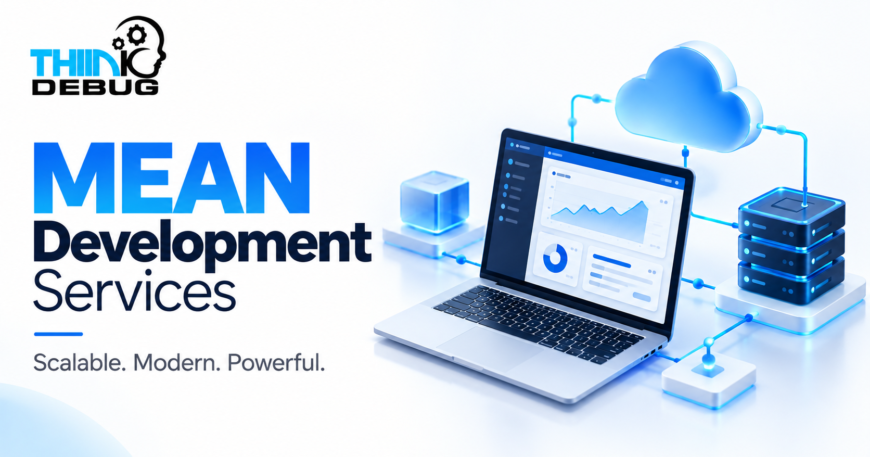
The MEAN stack provides a complete JavaScript-based technology stack for building modern web applications. It combines MongoDB, Express.js, Angular, and Node.js to support both frontend and backend development.
ThinkDebug provides MEAN development services focused on building scalable, high-performance web applications tailored to business requirements. The company lists MEAN development alongside MERN and other software development services.
What Is MEAN Stack Development?
MEAN is an acronym for four technologies:
- MongoDB – NoSQL database
- Express.js – Backend web application framework
- Angular – Frontend application framework
- Node.js – Server-side JavaScript runtime
One of the biggest advantages of MEAN development is that JavaScript and related technologies can be used throughout the application stack.
This can simplify development, improve collaboration between frontend and backend teams, and make it easier to maintain large web applications.
Why Choose MEAN Stack Development?
Different applications require different technology approaches. MEAN is particularly suitable for businesses looking to build structured, scalable, and feature-rich web applications.
Key benefits include:
- Full-stack JavaScript development
- Scalable application architecture
- Component-based frontend development
- Flexible database structure
- API-driven backend architecture
- Faster development cycles
- Strong support for enterprise applications
- Easier code maintenance
- Real-time application capabilities
- Cloud-ready architecture
The right technology stack ultimately depends on the application’s requirements, expected users, integrations, security needs, and long-term roadmap.
Custom MEAN Development Services
Off-the-shelf software cannot always accommodate unique business processes.
Custom MEAN development allows businesses to create applications around their specific workflows and operational requirements.
ThinkDebug can develop custom web solutions such as:
- Business management platforms
- SaaS applications
- Customer portals
- Admin dashboards
- Booking platforms
- Marketplaces
- Enterprise applications
- Workflow management systems
- Data management platforms
- Internal business tools
The architecture can be planned around current requirements while keeping future expansion in mind.
Angular for Powerful Frontend Applications
Angular is the frontend framework used in the MEAN stack.
It provides a structured approach to developing complex web applications and is particularly useful for applications containing multiple modules, forms, dashboards, workflows, and user roles.
Angular can be used to create:
- Interactive dashboards
- Customer portals
- Enterprise applications
- Admin panels
- Business management systems
- Data-driven applications
- Workflow platforms
Its component-based architecture also helps development teams organize large applications into reusable and manageable sections.
Node.js and Express.js Backend Development
A modern web application requires a reliable backend capable of handling business logic, APIs, authentication, integrations, and data processing.
Node.js provides the runtime environment, while Express.js can be used to build APIs and backend services.
A MEAN backend can support:
- REST APIs
- Authentication
- Authorization
- Payment integrations
- Third-party APIs
- Notifications
- File processing
- Business workflows
- Database operations
- Background processes
ThinkDebug’s broader software development capabilities include API development, third-party integrations, cloud integrations, payment gateway integration, and database synchronization.
MongoDB Development
MongoDB provides a flexible document-oriented database for applications where data structures may evolve over time.
It can be used for applications involving:
- User profiles
- Product catalogs
- Transactions
- Content management
- Business records
- Analytics data
- Customer information
However, database scalability depends on proper architecture rather than simply choosing a particular database.
Schema design, indexing, query optimization, data relationships, aggregation, and database security should all be considered during development.
MEAN SaaS Development
MEAN can be used to build SaaS products where multiple customers access software through the web.
A SaaS platform may require:
- User registration
- Login and authentication
- Subscription management
- Role-based permissions
- Organization management
- Billing
- Notifications
- Analytics
- Admin controls
- API access
A well-designed architecture can allow a product to evolve from an MVP into a larger commercial platform.
Enterprise MEAN Applications
Large organizations often require applications with complex workflows and multiple user roles.
Examples include:
- ERP platforms
- CRM systems
- HR management systems
- Business intelligence dashboards
- Workflow management platforms
- Supply chain systems
- Finance applications
- Internal enterprise portals
ThinkDebug’s software development services include enterprise software solutions such as ERP, CRM, HRMS, business intelligence tools, document management systems, and finance and accounting systems.
For enterprise applications, architecture, security, performance, maintainability, and integration capabilities should be considered from the beginning.
MEAN Dashboard Development
Businesses need visibility into their data to make better decisions.
MEAN can be used to build interactive dashboards for:
- Sales
- Finance
- Marketing
- Operations
- Inventory
- Customer management
- Employee management
- Business analytics
Dashboards can combine charts, tables, filters, reports, notifications, and other interactive components into a centralized interface.
API Development and Integration
Modern applications rarely work independently.
Businesses often need their software to communicate with other systems.
MEAN applications can integrate with:
- Payment gateways
- CRM platforms
- ERP systems
- Cloud services
- Email platforms
- SMS providers
- Analytics tools
- Authentication services
- AI APIs
- External business APIs
A well-structured API layer makes it easier to connect different systems and expand application functionality.
Real Time MEAN Applications
Some applications need information to update immediately without requiring users to refresh their browser.
Examples include:
- Chat applications
- Collaboration platforms
- Live dashboards
- Notification systems
- Monitoring platforms
- Tracking applications
- Customer support systems
Node.js provides a strong foundation for applications that require event-driven and real-time functionality.
Secure MEAN Application Development
Security needs to be incorporated throughout the development lifecycle.
Depending on the application, security considerations can include:
- Authentication
- Authorization
- Role-based access
- Input validation
- API security
- Secure password handling
- Token management
- Rate limiting
- Data protection
- Dependency security
- Logging and monitoring
Applications handling financial, personal, business, or sensitive information may require additional security controls based on their specific environment and regulatory requirements.
Scalable MEAN Architecture
Building an application that works today is only part of the challenge.
The application should also be capable of handling increasing users, transactions, data, and integrations.
Scalability planning can include:
- Modular architecture
- Efficient API design
- Database indexing
- Caching
- Background processing
- Load balancing
- Cloud infrastructure
- Containerization
- Monitoring
- Horizontal scaling
ThinkDebug emphasizes scalable and secure software architecture as part of its development approach.
MEAN Migration and Modernization
Many businesses still operate legacy applications that are difficult to maintain or expensive to extend.
Replacing everything at once is not always practical.
A phased modernization approach can involve:
- Auditing the existing application
- Identifying technical limitations
- Designing a modern architecture
- Migrating data
- Rebuilding priority modules
- Integrating legacy and new systems
- Testing the new platform
- Gradually migrating users
ThinkDebug provides legacy system modernization services covering technology upgrades, application re-engineering, data migration, cloud migration, and integration of modern features.
MEAN Application Testing
Testing is an important part of delivering a reliable production application.
Testing can include:
- Functional testing
- API testing
- Integration testing
- UI testing
- Performance testing
- Security testing
- Regression testing
- Cross-browser testing
- Responsive testing
Continuous testing becomes even more important as applications grow and new features are introduced.
MEAN Maintenance and Support
Software development does not end when an application goes live.
Over time, businesses need new features, security updates, performance improvements, bug fixes, and infrastructure changes.
Ongoing maintenance may include:
- Bug fixing
- Security updates
- Dependency upgrades
- Database optimization
- Performance monitoring
- Feature enhancements
- Infrastructure improvements
- Technical support
ThinkDebug provides ongoing software maintenance and support to keep applications updated, optimized, secure, and aligned with evolving business requirements.
MEAN vs MERN: Which One Should You Choose?
MEAN and MERN share three major technologies: MongoDB, Express.js, and Node.js.
The primary difference is the frontend technology.
MEAN uses Angular, while MERN uses React.
Angular provides a more structured framework for building large applications, while React offers a flexible component-based approach.
The better choice depends on:
- Application complexity
- Team expertise
- Project architecture
- Development preferences
- Long-term maintenance
- Existing technology ecosystem
- Business requirements
There is no universal winner. The technology should be selected based on the product rather than following trends.
Why Choose ThinkDebug for MEAN Development?
A successful application requires more than writing code.
ThinkDebug follows a full-cycle development approach covering requirements analysis, planning, design, development, testing, deployment, and ongoing support.
Its broader technology capabilities include modern frontend frameworks, Node.js, MongoDB, REST APIs, GraphQL, Docker, microservices, cloud platforms, and CI/CD tools.
This allows businesses to build applications with a technology foundation designed around their current requirements and future growth.
Final Thoughts
The MEAN stack provides a powerful foundation for businesses looking to build modern web applications with a structured frontend, scalable backend, flexible database, and API-driven architecture.
From SaaS platforms and enterprise applications to dashboards, marketplaces, and custom business systems, MEAN can support a wide range of digital products.
But the technology stack is only one part of the equation.
Good architecture, clean development practices, security, performance, testing, and long-term support are what turn a technology stack into a successful product.
If you’re planning a new web application or looking to modernize an existing platform, ThinkDebug can help you plan, design, develop, deploy, and maintain a scalable MEAN application.
Have a web application idea? Talk to ThinkDebug and turn it into a scalable digital product.
