

A great software idea does not guarantee a successful project.
Many technology projects struggle not because developers lack technical skills, but because requirements are unclear, priorities constantly change, communication breaks down, timelines become unrealistic, or risks are identified too late.
This is where professional project management services become essential.
Project management creates a structured bridge between business objectives and technical execution. It helps ensure that developers, designers, QA engineers, stakeholders, and decision-makers understand what needs to be delivered, when it needs to happen, and how success will be measured.
ThinkDebug officially provides project management services covering projects from conception through completion, with an emphasis on planning, execution, timelines, budgets, quality, and stakeholder satisfaction.
What Are Project Management Services?
Project management services involve planning, organizing, coordinating, monitoring, and controlling the activities required to successfully deliver a project.
For software and digital projects, this can involve:
- Requirement gathering
- Project planning
- Scope definition
- Technical coordination
- Task prioritization
- Sprint planning
- Resource allocation
- Timeline management
- Budget monitoring
- Risk management
- Quality control
- Stakeholder communication
- Progress reporting
- Release planning
- Delivery management
The objective is not simply to keep developers busy.
The objective is to ensure that development effort consistently moves the project toward measurable business goals.
Why Technology Projects Need Strong Project Management
Modern applications involve multiple moving parts.
A relatively simple digital product might require:
UI UX → Frontend → Backend → Database → APIs → QA → DevOps → Deployment
Larger products can involve multiple development teams, third-party vendors, cloud infrastructure, payment providers, mobile applications, external APIs, and business stakeholders.
Without structured coordination, dependencies can quickly become bottlenecks.
Strong project management helps create visibility across these moving parts.
Requirement Analysis
One of the most important stages of any software project happens before development begins.
Teams need to understand:
- What problem is being solved?
- Who will use the product?
- What functionality is required?
- Which features are essential?
- What integrations are needed?
- What are the technical constraints?
- What does the client expect from the final product?
Poor requirements frequently result in rework.
A structured requirement process converts business ideas into understandable features, workflows, user stories, acceptance criteria, and technical requirements.
ThinkDebug’s documented software development process begins with requirement analysis before moving into planning, UI/UX, development, testing, deployment, and maintenance.
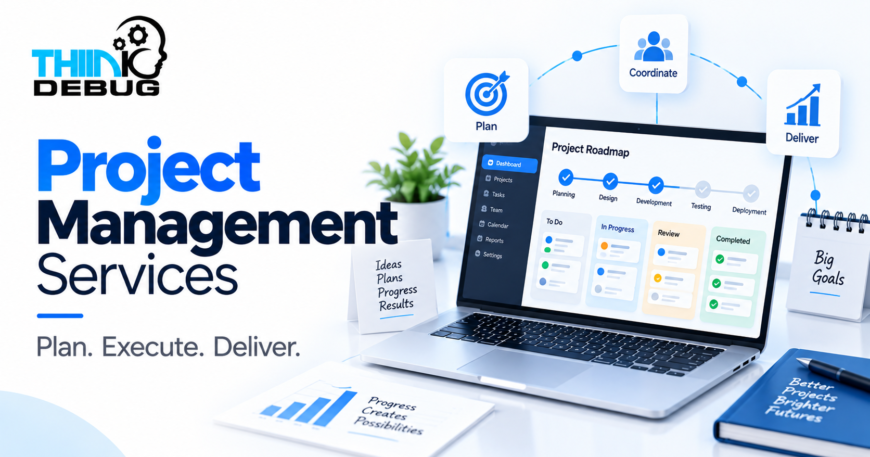
Project Planning and Roadmap Development
Once requirements are understood, the project needs a roadmap.
The roadmap breaks a large project into manageable phases.
For example:
Discovery → Design → Development → Testing → Deployment → Support
Each phase can then be divided into milestones, modules, features, and tasks.
A good project roadmap provides visibility into:
- Deliverables
- Dependencies
- Resources
- Priorities
- Risks
- Timelines
- Release targets
This gives both the client and development team a common understanding of how the project will progress.
Scope Management
Scope creep is one of the most common challenges in software development.
During development, new ideas naturally emerge.
A client may request another report, integration, dashboard, workflow, payment method, or user role.
Some changes are valuable.
But uncontrolled changes can significantly affect budgets and delivery schedules.
Project management creates a process for evaluating changes before implementation.
The team can determine:
What is changing?
Why is it required?
How much effort will it require?
Will it affect other features?
Does it change the timeline?
This makes project decisions more transparent.
Agile Project Management
Software requirements often evolve during development.
That is why many development teams use Agile approaches.
Instead of waiting months to deliver the entire application, development can be divided into shorter cycles or sprints.
A typical cycle may include:
- Sprint planning
- Development
- Testing
- Review
- Feedback
- Improvements
- Next sprint
This allows stakeholders to see progress regularly and provide feedback before development moves too far in the wrong direction.
ThinkDebug states that it uses an Agile development approach designed to support timely delivery and continuous improvements as requirements evolve.
Sprint Planning
Sprint planning determines what the development team should focus on during a particular development cycle.
Features are prioritized according to factors such as:
- Business importance
- Dependencies
- Technical complexity
- Customer impact
- Release requirements
- Available resources
Instead of trying to develop everything simultaneously, the team concentrates on achievable goals.
This creates greater predictability and accountability.
Resource Management
Technology projects often involve specialists with different skills.
A project might include:
- Project manager
- Business analyst
- UI/UX designer
- Frontend developer
- Backend developer
- Mobile developer
- QA engineer
- DevOps engineer
- Technical lead
Not every person needs to work on the project at the same intensity throughout its lifecycle.
Effective resource planning helps ensure that the appropriate expertise is available when required.
Timeline Management
Clients naturally want to know when their software will be ready.
But estimating software development requires more than assigning arbitrary deadlines.
Timelines depend on:
- Feature complexity
- Number of developers
- Integrations
- Dependencies
- Feedback cycles
- Testing requirements
- Technical uncertainty
- Scope changes
Good project management continuously compares planned progress against actual progress.
If delays occur, stakeholders should understand the cause and potential impact early rather than discovering the problem close to launch.
Risk Management
Every technology project contains uncertainty.
Potential risks might include:
- Third-party API delays
- Changing requirements
- Technical limitations
- Integration issues
- Performance problems
- Security vulnerabilities
- Resource availability
- Data migration complexity
- App-store approvals
- Infrastructure issues
Project managers should identify important risks early and create mitigation plans.
For example, if the product depends heavily on an external API, integration testing should happen early rather than waiting until the end of development.
Communication Management
Communication problems can damage even technically strong projects.
Clients need visibility into what is happening without having to constantly ask developers for updates.
A structured communication process can include:
- Regular project updates
- Sprint reviews
- Milestone reports
- Risk updates
- Requirement discussions
- Demo sessions
- Decision tracking
Communication should focus on clarity.
Stakeholders should understand what has been completed, what is currently being developed, what comes next, and whether anything requires their attention.
Software Quality Management
Delivering features quickly means little if those features are unreliable.
Quality assurance should therefore be integrated into the project lifecycle.
Testing can include:
- Functional testing
- API testing
- UI testing
- Integration testing
- Regression testing
- Performance testing
- Security testing
- Device testing
- Browser testing
ThinkDebug’s documented development process includes testing and quality assurance before deployment, followed by maintenance and support.
Budget Management
Software budgets need continuous visibility.
Project managers can track development effort against the planned budget and identify areas where additional requirements may increase costs.
Budget management becomes particularly important for long-running projects where scope evolves.
Instead of discovering a major cost increase late in development, stakeholders can make informed decisions throughout the project.
Managing Third Party Integrations
Modern software frequently depends on external platforms.
Examples include:
- Payment gateways
- CRM systems
- ERP platforms
- Travel APIs
- Maps
- Authentication providers
- SMS services
- Email platforms
- Cloud services
- Analytics systems
Every external integration introduces dependencies.
The project plan needs to consider documentation availability, credentials, sandbox environments, API limitations, testing, approval processes, and production deployment.
ThinkDebug’s software development offering includes API development, third-party integrations, cloud integrations, payment gateway integration, and CRM/ERP integration.
Project Management for Startups
Startups usually need speed, but speed without prioritization can waste development budgets.
Instead of attempting to launch every possible feature, project management can help identify the minimum functionality required to validate the product.
An MVP roadmap may follow:
Idea → Requirements → Prototype → MVP → User Feedback → Improvements → Scale
This helps startups focus development resources on functionality that creates immediate value.
Project Management for Enterprise Software
Enterprise projects often have significantly more dependencies.
They may involve:
- Multiple departments
- Existing legacy systems
- Large datasets
- Compliance requirements
- Complex user permissions
- ERP or CRM integrations
- Infrastructure teams
- External vendors
Enterprise project management therefore requires stronger documentation, dependency management, communication, risk management, and release planning.
ThinkDebug’s software portfolio includes enterprise solutions such as ERP, CRM, HRMS, business intelligence, document management, supply-chain systems, and finance applications.
Project Monitoring and Reporting
You cannot manage a project effectively without knowing its actual status.
Project monitoring can track indicators such as:
- Tasks completed
- Tasks pending
- Sprint progress
- Bugs
- Blockers
- Milestone status
- Resource utilization
- Delivery risks
Reporting should help stakeholders make decisions rather than simply produce more documentation.
The most useful project report answers three questions:
Where are we now?
What is blocking us?
What happens next?
Managing Project Changes
Changes are normal in software development.
The challenge is managing them deliberately.
When a new requirement appears, the team should evaluate its effect on scope, architecture, timeline, testing, and budget.
This prevents seemingly small additions from unexpectedly creating major project delays.
From Development to Deployment
Project management continues beyond feature development.
Before production release, teams may need to coordinate:
- Final QA
- Bug resolution
- Production infrastructure
- Database migration
- Domain configuration
- SSL
- Application builds
- App-store submissions
- Monitoring
- Backups
- Rollback planning
A structured release checklist significantly reduces avoidable deployment problems.
Post Launch Project Management
Launching the product is not the end of its lifecycle.
Real users often reveal new requirements.
After launch, teams may need to manage:
- Production bugs
- Performance improvements
- User feedback
- Analytics
- Feature requests
- Security updates
- Infrastructure scaling
- New releases
ThinkDebug describes its model as full-cycle development and emphasizes ongoing support and long-term client partnerships after deployment.
Why Choose ThinkDebug for Project Management Services?
Project management becomes particularly effective when the team managing the project also understands the technology behind it.
ThinkDebug works across web applications, mobile applications, custom software, UI/UX, APIs, databases, cloud platforms, integrations, and modern development technologies.
Its development process covers the complete journey from understanding requirements and strategic planning through development, testing, launch, and support.
This creates a structured approach where business requirements and technical execution can remain aligned throughout the development lifecycle.
Final Thoughts
Successful software development is not simply about writing good code.
Projects also need clear requirements, realistic planning, strong communication, disciplined execution, continuous testing, risk management, and transparent progress tracking.
Effective project management connects all of these elements.
Whether you are building an MVP, mobile application, SaaS platform, enterprise system, marketplace, or large custom software product, structured project management can help reduce uncertainty and keep development focused on the actual business objective.
Planning a software project but need stronger control over development, timelines, resources, and delivery?
ThinkDebug can help manage your project from initial requirements through development, testing, deployment, and ongoing support.
Turn your technology roadmap into an organized, measurable, and manageable development process.
