

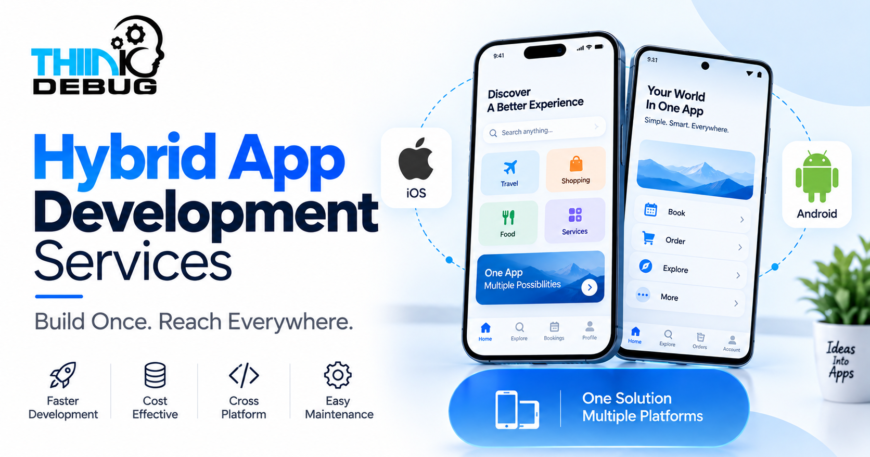
Businesses today want mobile applications that can reach users across multiple platforms without creating completely separate applications for every operating system.
That is where hybrid app development can be useful.
Hybrid applications allow businesses to build applications that can work across platforms while sharing a significant portion of the underlying codebase. This approach can help reduce duplicated development effort, simplify maintenance, and accelerate time to market.
ThinkDebug provides hybrid app development services focused on creating cross-platform applications with responsive interfaces, optimized performance, and business-specific functionality. Its official service portfolio describes hybrid development as combining the benefits of native and web applications with cross-platform compatibility and faster time to market.
What Is Hybrid App Development?
Hybrid app development is an approach to mobile application development where a shared application codebase is used to create applications for multiple platforms.
Instead of maintaining completely separate applications for Android and iOS, businesses can use a cross-platform development approach to share application logic and functionality.
Depending on the project requirements, hybrid or cross-platform applications can support:
- Android
- iOS
- Tablets
- Mobile-responsive experiences
- Backend APIs
- Cloud services
- Third-party integrations
The exact technology should be selected based on the application’s performance requirements, device capabilities, user experience, integrations, and long-term maintenance requirements.
Why Businesses Choose Hybrid App Development
Developing separate native applications can increase development effort because teams may need separate codebases, development processes, testing environments, and maintenance cycles.
A hybrid approach can reduce some of this duplication.
Potential advantages include:
- Faster development
- Shared codebase
- Cross-platform compatibility
- Lower development effort
- Easier maintenance
- Faster feature rollout
- Consistent user experience
- Simplified testing
- Easier updates
- Faster time to market
However, hybrid development is not automatically the right choice for every application. Applications requiring highly specialized device capabilities or extremely demanding native performance may require a different architecture.
Custom Hybrid App Development
Every business has different requirements.
ThinkDebug can develop customized mobile applications around specific business workflows rather than forcing businesses to adapt to generic application templates.
Custom hybrid applications can include:
- Customer applications
- Booking applications
- E-commerce apps
- Marketplace apps
- Service applications
- Business management apps
- Loyalty applications
- Delivery applications
- Education applications
- Travel applications
- On-demand applications
The application architecture can be designed around the required features, target users, integrations, and expected growth.
Hybrid E Commerce App Development
Mobile commerce has become an important channel for businesses selling products and services.
A hybrid e-commerce application can provide customers with a dedicated mobile shopping experience while allowing businesses to maintain shared application functionality across platforms.
Features can include:
- Product catalogs
- Categories
- Product search
- Filters
- Shopping cart
- Checkout
- Payment gateways
- Order tracking
- Coupons
- Wishlist
- Customer accounts
- Push notifications
A centralized backend can allow the mobile application to communicate with the existing website, inventory system, CRM, ERP, or payment infrastructure.
Hybrid Booking App Development
Businesses in travel, hospitality, healthcare, events, transportation, and other industries often require booking applications.
A hybrid booking application can support workflows such as:
- Browse available services
- Search and filter
- Select a date or time
- Choose a service
- Enter customer details
- Make payment
- Receive confirmation
- Track or manage the booking
API integrations can connect the application with external booking, payment, inventory, or scheduling systems.
Hybrid Business Applications
Not every mobile application is customer-facing.
Businesses can also use hybrid applications internally.
Examples include:
- Employee applications
- Sales management
- Field service management
- Inventory management
- Delivery management
- Attendance systems
- CRM applications
- Reporting dashboards
- Approval workflows
- Internal communication
A shared application can allow employees to access business systems from smartphones and tablets while keeping the underlying business logic centralized.
Hybrid App UI UX Design
A mobile application’s technology is only one part of the user experience.
Users expect applications to feel intuitive, responsive, and consistent.
The design process should therefore consider:
- Navigation
- Screen hierarchy
- Touch interactions
- Typography
- Forms
- Buttons
- Loading states
- Error messages
- Empty states
- Accessibility
- Responsive layouts
ThinkDebug provides UI/UX design alongside application development, allowing the interface and technical architecture to be planned together. Its services portfolio includes UI/UX design, mobile app development, web applications, and full-cycle development.
API Integration for Hybrid Applications
Most modern mobile applications depend on backend APIs.
A hybrid application may need to connect with:
- Payment gateways
- CRM systems
- ERP systems
- E-commerce platforms
- Booking engines
- Cloud services
- Maps
- Authentication providers
- Analytics platforms
- Communication services
- AI APIs
A properly designed API layer keeps mobile applications connected to business data while allowing the backend to evolve independently.
ThinkDebug’s software development services include API development and integration as part of its broader application development capabilities.
Push Notifications
Push notifications can help businesses communicate directly with application users.
Depending on the business model, notifications can be used for:
- Order updates
- Booking confirmations
- Payment updates
- Promotional offers
- Appointment reminders
- New messages
- Account alerts
- Delivery updates
Notification architecture should include appropriate permission handling, device-token management, backend integration, and deep linking so users can be taken to the relevant screen when they interact with a notification.
Hybrid Apps and Backend Development
The mobile application is only one part of a complete digital product.
A production-ready application may require:
Mobile App → API Layer → Business Logic → Database → Third-Party Services
This architecture allows the mobile application to communicate with centralized business systems.
ThinkDebug follows a full-cycle development approach that covers requirements, planning, design, development, testing, deployment, and ongoing support.
Hybrid App Testing
Cross-platform applications need testing across different devices, operating systems, screen sizes, and hardware configurations.
Testing can include:
- Functional testing
- UI testing
- API testing
- Device testing
- Android testing
- iOS testing
- Performance testing
- Network testing
- Security testing
- Regression testing
- Push notification testing
- Payment testing
Testing on real devices is particularly important for applications that use cameras, GPS, Bluetooth, notifications, biometrics, or other device capabilities.
Hybrid App Performance Optimization
Performance directly affects the user experience.
Slow screens, excessive loading times, crashes, or inefficient network requests can lead to poor application experiences.
Performance optimization can involve:
- Optimizing API calls
- Reducing unnecessary network requests
- Image optimization
- Efficient data loading
- Caching
- Lazy loading
- Database optimization
- Memory management
- Reducing application bundle size
- Monitoring application performance
The appropriate optimization strategy depends on the application’s architecture and usage patterns.
Hybrid App Security
Mobile applications frequently handle sensitive information, including user profiles, payment information, business records, and authentication credentials.
Security should therefore be incorporated throughout development.
Important areas can include:
- Secure authentication
- Authorization
- Token management
- API security
- Input validation
- Secure data storage
- Encryption where appropriate
- Certificate and network security
- Dependency management
- Secure logging
- Access control
The backend and mobile application should be treated as one security architecture rather than separate systems.
Hybrid App Development for Startups
Startups often need to validate an idea quickly before investing heavily in separate applications.
A hybrid approach can help create an MVP with a shared codebase and allow the business to test:
- Product-market fit
- User engagement
- Customer workflows
- Pricing
- Core features
- Retention
Once the product gains traction, the architecture can be expanded based on actual usage rather than assumptions.
Hybrid App Development for Enterprises
Enterprises often have existing systems that need a mobile interface.
Instead of replacing the entire backend, a hybrid mobile application can connect to existing business systems through APIs.
For example:
Existing ERP → API → Hybrid Mobile Application
This can allow employees to access inventory, orders, reports, approvals, or customer information from mobile devices without rebuilding the underlying enterprise platform.
ThinkDebug also provides enterprise software development and system modernization services, making mobile applications part of a broader digital transformation strategy.
Hybrid App Maintenance and Support
Mobile applications require continuous maintenance after launch.
Operating systems change, dependencies receive updates, APIs evolve, and businesses introduce new requirements.
Ongoing maintenance may include:
- Bug fixing
- OS compatibility updates
- Dependency updates
- Performance improvements
- Security updates
- New features
- API changes
- UI improvements
- Analytics monitoring
- Application store updates
ThinkDebug’s full-cycle approach includes ongoing support after deployment, helping businesses maintain and improve their applications over time.
Why Choose ThinkDebug for Hybrid App Development?
A successful mobile application requires more than cross-platform coding.
It requires business understanding, UX planning, backend architecture, API integration, testing, deployment, and ongoing support.
ThinkDebug describes its development approach as client-centric and agile, with services covering the complete development lifecycle from concept to deployment and support.
Its technology capabilities span web, mobile, backend, APIs, databases, cloud infrastructure, and modern development frameworks, allowing hybrid applications to be integrated into larger digital ecosystems.
Final Thoughts
Hybrid app development can provide businesses with a practical way to reach Android and iOS users while sharing application logic and reducing duplicated development effort.
It can be particularly useful for startups, businesses launching new digital products, companies extending existing web platforms into mobile, and organizations that need mobile access to their internal systems.
The key is not simply choosing hybrid technology.
The application should be designed around performance, usability, security, scalability, integrations, and long-term maintenance from the beginning.
If you’re planning a new mobile application or want to bring an existing web or business platform to mobile, ThinkDebug can help you plan, design, develop, test, deploy, and maintain a cross-platform application.
Have a mobile app idea? Talk to ThinkDebug and turn it into a scalable digital product.
