

How API Development and Integration Services Improve Business Efficiency in 2026
Modern businesses rely on multiple software platforms to manage operations, customers, finances, marketing, and communication. While these systems provide valuable functionality, they often operate in isolation.
Disconnected applications create inefficiencies, duplicate work, and data inconsistencies that slow business growth.
This is why API development and integration services have become essential for organizations seeking seamless digital operations.
In 2026, businesses are increasingly using APIs to connect systems, automate workflows, and create unified digital ecosystems that improve efficiency and customer experiences.
What Is an API?
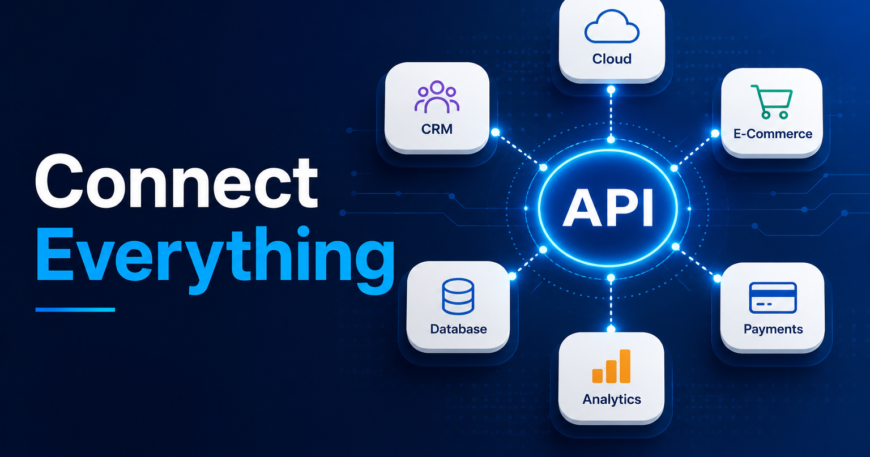
An API (Application Programming Interface) allows different software applications to communicate and exchange data.
Think of an API as a bridge that enables systems to work together without requiring manual intervention.
Examples include:
- CRM and ERP integrations
- Payment gateway integrations
- Mobile app integrations
- Cloud platform integrations
- E-commerce platform connections
- Third-party software integrations
APIs help organizations eliminate silos and create smooth data flows across business systems.
Why Businesses Need API Integration
Many companies use multiple software solutions for different business functions.
Without proper integration, employees often need to:
- Enter the same data multiple times
- Switch between systems
- Create manual reports
- Manage disconnected workflows
These inefficiencies increase operational costs and reduce productivity.
API integration solves these challenges by enabling automated communication between systems.
Benefits of API Development and Integration
Improved Operational Efficiency
APIs automate repetitive processes and reduce manual data entry.
This allows teams to focus on higher-value activities.
Better Data Accuracy
Data automatically syncs between systems, reducing errors caused by manual updates.
Enhanced Customer Experience
Integrated systems provide faster service, personalized interactions, and real-time information.
Faster Business Processes
Workflows that previously required multiple steps can be completed automatically.
Greater Scalability
As businesses grow, APIs make it easier to connect new tools and technologies.
Real-World Example
Imagine an e-commerce business using separate systems for inventory management, customer relationships, accounting, and shipping.
Without integration, employees manually transfer information between platforms.
After implementing API integrations, orders automatically update inventory, generate invoices, notify shipping providers, and synchronize customer records.
The result is faster processing, fewer errors, and improved customer satisfaction.
Industries Benefiting from API Integration
Healthcare
Connect patient management systems, laboratories, and healthcare applications.
Finance
Enable secure payment processing and financial data exchange.
Retail
Integrate inventory, sales, customer, and logistics systems.
Education
Connect learning platforms with student management systems.
Logistics
Improve real-time tracking and supply chain visibility.
API Trends in 2026
API-First Development
Businesses are designing applications with APIs as a foundational component.
AI-Powered Integrations
Artificial intelligence is helping automate data mapping and workflow optimization.
Microservices Architecture
Organizations are building flexible systems that communicate through APIs.
Real-Time Data Synchronization
Businesses increasingly require instant access to accurate information.
Enhanced API Security
Companies are investing in stronger authentication and access control mechanisms.
Common API Implementation Mistakes
Businesses should avoid:
- Poor API documentation
- Weak security practices
- Lack of scalability planning
- Ignoring performance optimization
- Inadequate monitoring and maintenance
Successful API strategies focus on reliability, security, and long-term business objectives.
How ThinkDebug Helps
ThinkDebug develops secure and scalable APIs that connect business systems and streamline operations.
Our services include:
- Custom API Development
- REST API Development
- Third-Party API Integration
- Payment Gateway Integration
- CRM & ERP Integration
- Cloud API Services
- API Maintenance & Optimization
We help organizations build connected digital ecosystems that improve efficiency and support growth.
Conclusion
Businesses can no longer afford disconnected systems and manual workflows.
API development and integration provide the foundation for automation, scalability, and seamless digital experiences.
In 2026, organizations that invest in API-driven connectivity gain improved efficiency, stronger customer experiences, and a significant competitive advantage

