

Moving applications to the cloud can help businesses scale faster, improve flexibility, and reduce the burden of managing physical infrastructure.
However, cloud spending can become difficult to control as applications grow.
Development environments remain active when nobody uses them. Servers run at higher capacities than necessary. Storage accumulates over time, and businesses continue paying for resources that provide little value.
These expenses may appear small individually, but together they can significantly increase monthly infrastructure costs.
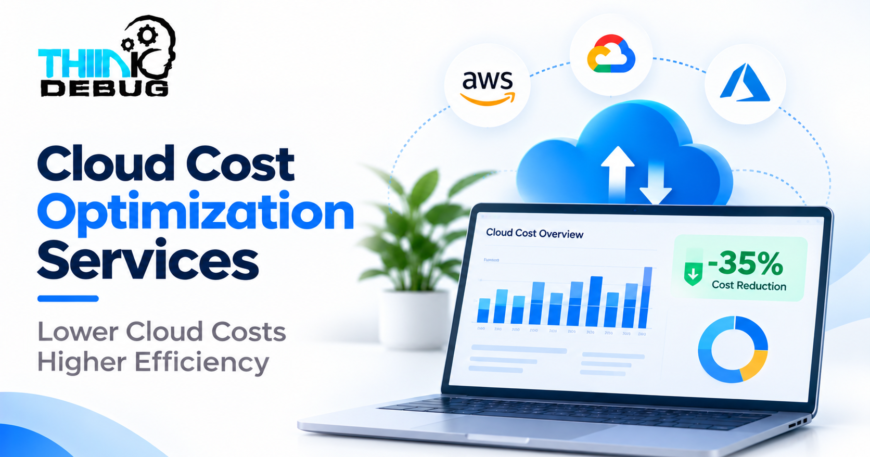
Cloud cost optimization services help businesses understand where their cloud budget goes, identify unnecessary spending, and make infrastructure more efficient without compromising application performance.
What Is Cloud Cost Optimization?
Cloud cost optimization is the process of managing cloud resources to achieve the best balance between cost, performance, reliability, and scalability.
It involves reviewing infrastructure usage, understanding billing patterns, removing waste, and matching resources to actual application requirements.
The objective is not simply to choose the cheapest server.
An undersized server can cause slow applications, failed requests, and poor customer experiences. Similarly, an oversized server can waste money without delivering meaningful benefits.
Effective optimization ensures that businesses pay for resources they need while avoiding unnecessary expenditure.
Why Cloud Costs Increase Over Time
Cloud infrastructure often evolves as applications gain users, features, and integrations.
Without regular reviews, the original infrastructure setup may no longer match current requirements.
1. Oversized Servers
Businesses sometimes select powerful servers to prepare for future growth but never review whether that capacity is actually required.
Right-sizing infrastructure can reduce costs when workloads consistently use only a fraction of the available resources.
2. Unused Resources
Temporary servers, abandoned testing environments, unattached storage volumes, and outdated snapshots can continue generating charges.
Identifying and removing unnecessary resources is often a practical starting point.
3. Inefficient Storage
Applications may retain old backups, duplicate files, unnecessary logs, or data that no longer requires frequent access.
Appropriate retention policies and storage tiers can help control these expenses.
4. Poor Scaling Configuration
Applications may run continuously at peak capacity even when demand is low.
Conversely, poorly configured scaling can create performance problems during traffic spikes.
Matching capacity to workload demand can improve both cost efficiency and reliability.
5. Unmonitored Data Transfer
Data transfer between regions, availability zones, services, and external systems can create unexpected costs.
Reviewing architecture and traffic patterns helps teams understand where these expenses originate.
Key Cloud Cost Optimization Strategies
Right-Size Compute Resources
Analyze CPU usage, memory consumption, traffic patterns, and application response times before changing server sizes.
The goal is to select resources that meet performance requirements without paying for unnecessary capacity.
Automate Non-Production Environments
Development, testing, and staging environments often do not need to run around the clock.
Where appropriate, scheduled shutdowns and automated startup procedures can reduce spending while preserving developer productivity.
Optimize Storage and Backups
Review storage growth, retention requirements, backup schedules, and recovery objectives.
Older data may be moved to lower-cost storage tiers when access requirements permit. Unnecessary copies can be removed only after verifying that they are not required for recovery or compliance.
Configure Auto Scaling
Auto scaling allows infrastructure capacity to respond to changing workloads.
When properly configured, it can help businesses handle traffic increases while reducing excess capacity during quieter periods.
Scaling policies should be tested against realistic traffic patterns to avoid unnecessary resource changes or performance issues.
Review Cloud Pricing Options
Cloud providers may offer different pricing models, including on-demand resources, committed-use discounts, and spot capacity.
The appropriate choice depends on workload predictability, interruption tolerance, contract terms, and expected usage.
Critical production workloads should not be moved to interruptible capacity without a suitable reliability strategy.
Cloud Cost Monitoring and Budget Alerts
Cost optimization should be an ongoing activity rather than a one-time cleanup.
Businesses need visibility into how infrastructure spending changes over time.
A practical monitoring approach can include:
-
Monthly spending reports
-
Budget alerts
-
Service-level cost breakdowns
-
Resource utilization dashboards
-
Unusual spending notifications
-
Cost allocation by project or environment
For example, if a new deployment causes database costs to increase unexpectedly, monitoring can help the team investigate before the expense continues for several billing cycles.
Budgets and alerts do not automatically prevent overspending, but they make cost changes easier to identify and investigate.
FinOps: Bringing Engineering and Finance Together
Cloud spending is not only an infrastructure concern.
Engineering teams make decisions about architecture and resource consumption, while finance teams need to understand costs and budgets. Business leaders need to evaluate whether infrastructure spending supports growth.
FinOps encourages these teams to share responsibility for cloud expenditure.
A practical FinOps approach can include assigning costs to projects, reviewing spending trends, tracking unit costs, and evaluating the financial impact of technical decisions.
For example, a business might track infrastructure cost per active customer or per transaction rather than looking only at the total monthly bill.
This provides better context as the business grows.
Cloud Cost Optimization Without Performance Problems
Cost reduction should never come at the expense of application stability.
Before changing infrastructure, businesses should understand performance baselines, availability requirements, backup policies, and recovery procedures.
A responsible optimization process includes:
-
Measuring current performance and spending
-
Identifying potential waste
-
Prioritizing low-risk improvements
-
Testing changes in suitable environments
-
Monitoring performance after deployment
-
Comparing actual savings against expectations
This helps ensure that cost reductions produce measurable benefits without introducing avoidable operational risks.
When Should You Consider Cloud Cost Optimization?
Cloud cost optimization can be especially useful when:
-
Monthly cloud bills are increasing unexpectedly.
-
Infrastructure utilization remains consistently low.
-
Applications have unused development environments.
-
Businesses are preparing to scale.
-
Multiple cloud services make spending difficult to track.
-
Infrastructure costs are growing faster than revenue.
-
Teams lack clear ownership of cloud expenses.
Even businesses with relatively small cloud environments can benefit from regular resource reviews.
How ThinkDebug Can Help
ThinkDebug provides software development and infrastructure-related expertise to help businesses build and maintain reliable digital solutions. Its broader development services include cloud-related work, application deployment, and ongoing technical support.
A cloud cost optimization engagement can focus on understanding the existing architecture, reviewing resource utilization, identifying unnecessary expenses, and recommending practical improvements.
Depending on the environment, this may involve server right-sizing, storage optimization, workload scheduling, monitoring configuration, or scaling improvements.
The appropriate recommendations should be based on actual billing data, infrastructure metrics, application requirements, and business priorities—not assumptions about where savings should occur.
Conclusion
Cloud infrastructure should support business growth without creating unnecessary financial pressure.
Cloud cost optimization services help businesses identify wasted resources, improve utilization, understand spending patterns, and make informed infrastructure decisions.
The best approach balances financial efficiency with application performance, security, reliability, and future growth.
Are your cloud bills increasing without a clear reason? Contact ThinkDebug to review your infrastructure and identify practical opportunities to control cloud spending.
