

Your website is often the first serious interaction a potential customer has with your business.
Before contacting your team, requesting a quotation, booking a service, or making a purchase, customers frequently evaluate your website to understand who you are, what you offer, and whether they can trust your business.
That makes website design more than a visual exercise.
A professional website needs to combine design, usability, performance, responsiveness, branding, SEO, and conversion-focused user experience.
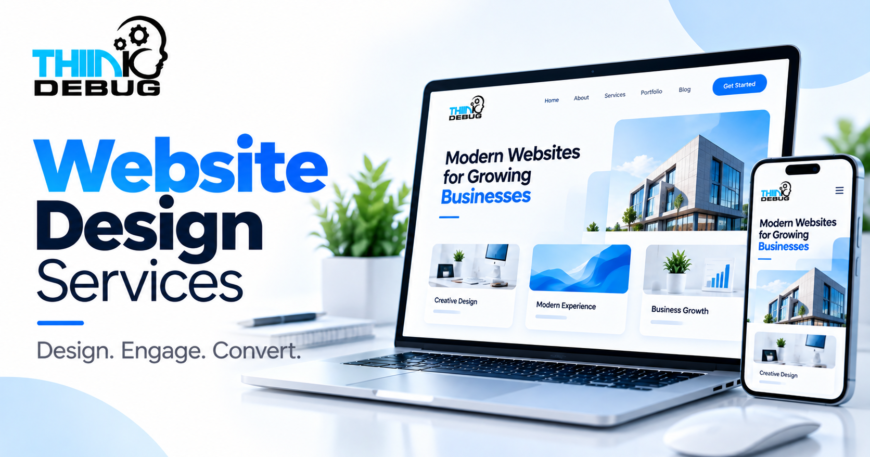
ThinkDebug provides website design services focused on creating responsive, user-friendly websites tailored to a business’s brand and objectives. Its official website highlights responsive design, seamless navigation, engagement, and modern user experiences as key aspects of its website design offering.
What Are Website Design Services?
Website design services involve planning and creating the visual and functional experience of a website.
This can include:
- Website structure
- UI design
- UX design
- Responsive layouts
- Brand integration
- Landing pages
- Navigation
- Typography
- Color systems
- Interactive elements
- Conversion-focused sections
- Mobile optimization
- Website usability
A professionally designed website should make it easy for visitors to understand the business and take the next step.
That next step could be:
Contact → Book → Buy → Register → Request a Quote → Download → Subscribe
The design should support that objective.
Why Professional Website Design Matters
A website can contain excellent information and still perform poorly if visitors struggle to use it.
Common problems include:
- Confusing navigation
- Slow-loading pages
- Poor mobile experience
- Weak visual hierarchy
- Difficult-to-find contact information
- Unclear calls to action
- Outdated design
- Inconsistent branding
- Complicated forms
Professional website design addresses these issues by creating an experience around how real users interact with the website.
Custom Website Design
Every business has a different audience, brand identity, and objective.
A law firm, SaaS company, restaurant, technology company, healthcare provider, and e-commerce business should not necessarily use the same website structure.
Custom website design allows the website to be built around:
- Business objectives
- Target audience
- Brand identity
- Industry
- Customer journey
- Content strategy
- Conversion goals
- Technical requirements
The result is a website designed specifically for the organization rather than simply adapting a generic template.
UI UX Design for Websites
UI and UX are closely connected but serve different purposes.
UI — User Interface focuses on the visual elements users interact with.
UX — User Experience focuses on how easily and effectively users can accomplish their goals.
A good website needs both.
For example, a beautiful contact button is useful only if visitors can easily find it, understand what happens after clicking it, and complete the form without unnecessary friction.
ThinkDebug’s website design offering emphasizes intuitive navigation, responsive design, visual quality, and alignment with business goals.
Responsive Website Design
Customers access websites from many different devices.
A website may be viewed on:
- Desktop computers
- Laptops
- Tablets
- Smartphones
- Large monitors
Responsive design allows the layout to adapt to different screen sizes.
Important elements include:
- Flexible layouts
- Responsive images
- Mobile navigation
- Touch-friendly buttons
- Readable typography
- Proper spacing
- Responsive forms
- Mobile-friendly tables and content
A website should not simply “shrink” on mobile.
The experience should be intentionally designed for smaller screens.
Business Website Design
A business website should communicate three things quickly:
Who are you?
What do you offer?
Why should someone choose you?
A strong business website may include:
- Homepage
- About section
- Services
- Industries
- Portfolio
- Case studies
- Testimonials
- Blog
- FAQ
- Contact page
The exact structure depends on the business and its customers.
Landing Page Design
Landing pages are designed around specific conversion objectives.
For example:
Google Ads → Landing Page → Lead Form → Sales Team
A landing page should minimize distractions and clearly communicate:
- The customer’s problem
- The offered solution
- Key benefits
- Supporting proof
- Call to action
Landing page design is particularly important for businesses investing in paid advertising or lead-generation campaigns.
E Commerce Website Design
E-commerce websites require a different design approach because customers need to browse products and complete transactions.
Important elements include:
- Product discovery
- Search
- Filters
- Product images
- Product information
- Reviews
- Cart
- Checkout
- Payment
- Order tracking
The design should minimize friction between discovering a product and completing the purchase.
Corporate Website Design
Large companies often need websites that communicate their brand while serving different audiences.
A corporate website may need sections for:
- Products
- Services
- Investors
- Careers
- Partners
- Media
- Resources
- Corporate information
- Contact locations
Information architecture becomes particularly important because visitors may arrive with completely different objectives.
Website Redesign Services
An outdated website does not necessarily need to be abandoned and rebuilt from scratch.
A website redesign can start with an audit of the existing platform.
The process may include:
- Reviewing current pages
- Understanding user behavior
- Identifying usability problems
- Reviewing competitors
- Improving information architecture
- Creating a new visual direction
- Redesigning important pages
- Improving mobile responsiveness
- Optimizing performance
- Testing before launch
The goal should be to improve the website’s business performance rather than simply make it look newer.
SEO Friendly Website Design
Design and SEO should not be treated as completely separate disciplines.
A visually impressive website can still struggle in search engines if its technical structure and content architecture are poor.
SEO-friendly design can consider:
- Page structure
- Heading hierarchy
- Internal linking
- Search-friendly URLs
- Mobile responsiveness
- Page performance
- Image optimization
- Content hierarchy
- Structured data where appropriate
ThinkDebug also provides SEO services focused on improving search visibility, organic traffic, technical SEO, and user experience.
Website Performance
Users expect websites to respond quickly.
Performance can be affected by:
- Large images
- Excessive scripts
- Poorly optimized code
- Heavy animations
- Third-party services
- Inefficient APIs
- Hosting configuration
- Database queries
Performance optimization can involve image compression, caching, code optimization, efficient API calls, content delivery networks, and appropriate infrastructure.
Performance should be considered during design and development rather than treated as a final-stage activity.
Website Design and Conversion Optimization
A website’s purpose is not simply to generate page views.
For many businesses, the real objective is generating actions.
These may include:
- Phone calls
- Contact forms
- Demo requests
- Purchases
- Bookings
- Registrations
- Newsletter subscriptions
Conversion-focused design considers the entire user journey.
For example:
Visitor → Service Page → Case Study → Trust Signal → CTA → Lead
Each step should make the next action obvious.
Website Design for Startups
Startups often need to establish credibility quickly.
A startup website may need to communicate:
- What the product does
- Who it is for
- Why it matters
- How it works
- Pricing
- Social proof
- Product demonstrations
- Contact information
The website can then evolve as the startup receives customer feedback and develops its product.
A well-designed MVP website should communicate the core value proposition without unnecessarily complicating the experience.
Website Design for Established Businesses
Established businesses often have a different challenge.
Their websites may have accumulated years of content, multiple services, outdated pages, and inconsistent designs.
A redesign can help bring these elements together into a clearer digital experience.
This may involve restructuring:
Content → Navigation → Branding → User Journey → Conversion
The goal is to create a website that reflects the company’s current position rather than its history.
Website Development and Design Together
Design decisions should consider technical implementation from the beginning.
A design may look excellent in a prototype but become difficult to maintain if it ignores the underlying architecture.
ThinkDebug provides both website design and web application development, allowing design and development considerations to be addressed together. Its website highlights website design, web application development, software development, mobile applications, and UI/UX as part of its broader service portfolio.
This can be particularly useful for businesses requiring custom functionality rather than a simple informational website.
Website Testing
Before launching a website, the experience should be tested across different environments.
Testing can include:
- Desktop browsers
- Mobile browsers
- Tablets
- Different screen sizes
- Navigation
- Forms
- Links
- Images
- Checkout
- Contact functionality
- Performance
- Accessibility
- Responsive layouts
Testing helps identify problems that may not be visible during the initial design process.
Website Maintenance
A website should continue evolving after launch.
Businesses may need:
- New pages
- New services
- Content updates
- Security updates
- Performance improvements
- SEO improvements
- New integrations
- Design updates
- Bug fixes
Ongoing maintenance helps keep the website aligned with changing business requirements and technology.
Why Choose ThinkDebug for Website Design?
Website design becomes more effective when it is connected to the larger digital strategy.
ThinkDebug works across website design, web application development, mobile applications, UI/UX, software development, SEO, digital marketing, and business consultation.
Its development process covers understanding business requirements, strategic planning and design, development and implementation, followed by testing, launch, and support.
This allows a website to be approached as a business asset rather than simply a collection of web pages.
Final Thoughts
Your website is more than your digital brochure.
It is often where customers form their first impression, evaluate your credibility, understand your offering, and decide whether to take action.
A successful website combines visual design, usability, responsive development, performance, SEO, content, and conversion strategy.
Whether you need a new corporate website, e-commerce platform, landing page, startup website, or complete redesign, the right design approach can turn your website into a stronger business acquisition and communication channel.
Planning a new website or redesigning an outdated one?
ThinkDebug can help you design and develop a modern, responsive, user-focused website aligned with your business goals.
Turn your website into an experience that attracts, engages, and converts.
