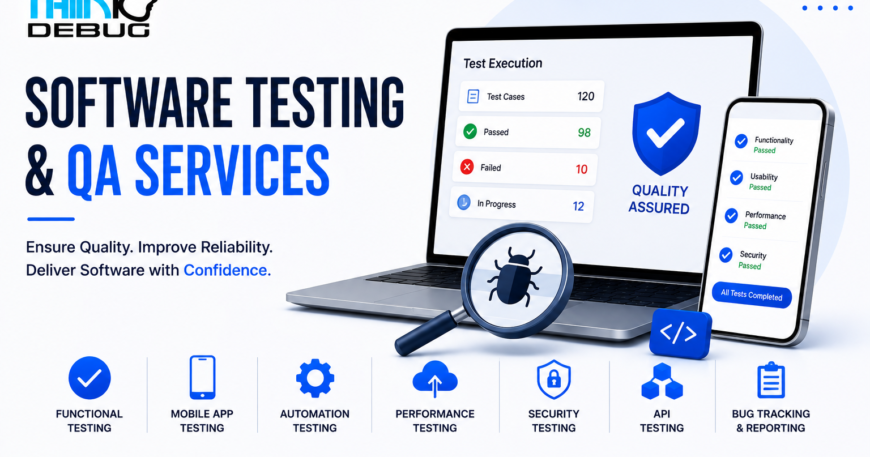
Software Testing and QA Services: Deliver Reliable Software with Confidence
Software quality directly affects customer experience, business operations, and brand reputation. A small application issue can lead to failed transactions, frustrated customers, inaccurate data, or unexpected downtime.
As applications become more complex, testing needs to cover more than basic functionality. Modern software needs to work across devices, browsers, operating systems, APIs, integrations, network conditions, and different user scenarios.
At ThinkDebug, we provide software testing and quality assurance services that help businesses identify defects early, improve application reliability, and release software with greater confidence.
What is Software Testing?
Software testing is the process of evaluating an application to determine whether it works according to its requirements and performs reliably under expected conditions.
Testing helps identify:
• Functional issues
• UI problems
• Performance bottlenecks
• Security vulnerabilities
• Integration failures
• Compatibility problems
• Data inconsistencies
• Usability issues
The objective is to find problems before they affect real users.
Why Software Testing Matters
Releasing software without adequate testing can create significant business risks.
Poorly tested applications can result in:
• Customer complaints
• Failed transactions
• Application crashes
• Data errors
• Security incidents
• Negative reviews
• Increased support costs
• Delayed releases
A structured QA process helps reduce these risks before software reaches production.
Our Software Testing Services
ThinkDebug provides comprehensive testing services for different types of applications.
Functional Testing
We verify whether application features work according to business and technical requirements.
Testing can cover:
• User registration
• Login
• Payments
• Search
• Forms
• Notifications
• Reports
• User management
• Business workflows
Manual Testing
Our QA process includes detailed manual testing for functionality, usability, workflows, and edge cases.
Manual testing is particularly useful for scenarios that require human judgment and exploratory evaluation.
Automation Testing
Automated testing helps repeatedly validate critical application functionality.
Automation can be used for:
• Regression testing
• Login workflows
• Checkout processes
• API testing
• Form validation
• Critical user journeys
Automated tests can run as part of the development and deployment pipeline.
API Testing
Modern applications depend heavily on APIs.
We test APIs for:
• Request validation
• Response accuracy
• Authentication
• Authorization
• Error handling
• Data consistency
• Response time
• Integration behavior
API testing can identify backend problems before they appear in the application’s user interface.
Mobile App Testing
Mobile applications need to work across different devices, screen sizes, operating systems, and network conditions.
We test Android and iOS applications for:
• Installation
• Login
• Navigation
• UI responsiveness
• Device compatibility
• Notifications
• Permissions
• Network interruptions
• Background behavior
• App performance
• Updates
This helps create a more consistent mobile experience.
Web Application Testing
Web applications need to work across different browsers and screen sizes.
Our testing can include:
• Chrome
• Safari
• Firefox
• Edge
We also test responsive behavior across desktop, tablet, and mobile screen sizes.
Regression Testing
Application changes can sometimes affect features that previously worked correctly.
Regression testing verifies that existing functionality continues to work after:
• New feature releases
• Bug fixes
• Backend changes
• API updates
• Database changes
• UI modifications
• Infrastructure changes
This is especially important for applications that release updates frequently.
Performance Testing
Performance issues can affect user experience and business results.
We evaluate applications for:
• Response time
• Load handling
• Concurrent users
• Server performance
• API performance
• Database performance
• Resource usage
Performance testing helps identify bottlenecks before they become production problems.
Security Testing
Security testing helps identify weaknesses that could expose applications or business data.
Testing can cover:
• Authentication
• Authorization
• Session management
• API security
• Input validation
• Access controls
• Common application vulnerabilities
Security testing should be part of the development lifecycle rather than something performed only before launch.
User Acceptance Testing
User Acceptance Testing evaluates whether the application meets actual business requirements.
We help validate important business workflows from the perspective of real users.
This can include:
• Customer journeys
• Employee workflows
• Sales processes
• Booking processes
• Payment workflows
• Administrative operations
UAT helps confirm that the final product solves the intended business problem.
Test Case Development
A structured testing process requires clear test cases.
We create test scenarios covering:
• Positive cases
• Negative cases
• Edge cases
• User permissions
• Validation rules
• Integration workflows
• Error scenarios
• Device and browser variations
Test documentation also makes future regression testing more efficient.
QA for Agile Development
Modern development teams often release features continuously.
Our QA approach can integrate into Agile development workflows through:
• Requirement analysis
• Test planning
• Sprint testing
• Regression testing
• Bug reporting
• Retesting
• Release validation
• Production verification
This allows quality assurance to remain part of the development process instead of becoming a final step before deployment.
Bug Reporting and Tracking
When an issue is identified, clear documentation helps developers resolve it faster.
Our bug reports can include:
• Issue description
• Steps to reproduce
• Expected behavior
• Actual behavior
• Environment details
• Screenshots or recordings
• Severity
• Priority
• Retesting status
This creates a structured communication process between QA and development teams.
Technologies and Tools
Our testing approach can use different tools depending on project requirements.
These can include:
• Selenium
• Playwright
• Cypress
• Postman
• Appium
• JMeter
• Browser testing tools
• API testing tools
• CI/CD platforms
• Issue tracking systems
The testing stack is selected according to the application architecture and testing objectives.
Applications We Test
Our QA services can support:
• Web applications
• Mobile applications
• SaaS platforms
• Ecommerce platforms
• APIs
• Enterprise applications
• CRM systems
• Booking platforms
• Marketplaces
• AI powered applications
Industries We Serve
We support software testing requirements across:
• Healthcare
• Finance
• Ecommerce
• Education
• Travel
• Hospitality
• Logistics
• Real Estate
• Manufacturing
• SaaS
• Professional Services
Testing strategies are adapted to the application’s functionality, users, integrations, and business risks.
Why Choose ThinkDebug?
ThinkDebug combines software development and QA expertise.
This gives our testing team a better understanding of application architecture, APIs, databases, cloud infrastructure, and business workflows.
Our QA process includes:
• Requirement analysis
• Test planning
• Test case creation
• Manual testing
• Automation testing
• API testing
• Regression testing
• Performance testing
• Bug tracking
• Release validation
• Ongoing QA support
Benefits of Professional Software Testing
A structured QA process can help businesses achieve:
• Fewer production defects
• Better application stability
• Improved user experience
• Faster issue detection
• More reliable releases
• Reduced support costs
• Better security
• Higher customer confidence
• More predictable development cycles
Build and Release Better Software
Software quality should be considered throughout development, not after the application is finished.
ThinkDebug helps businesses introduce structured testing and QA practices across web applications, mobile apps, APIs, SaaS platforms, and enterprise software.
Whether you are launching a new product or improving an existing application, our software testing services can help you identify issues earlier and deliver a more reliable product.
Contact ThinkDebug today to discuss your software testing and QA requirements

