

Why Businesses Are Investing in ERP Development Services for Smarter Operations
As businesses grow, managing operations becomes increasingly complex. Departments often use different software systems for finance, inventory, sales, procurement, human resources, and customer management.
While each system may perform its individual function well, disconnected processes often create inefficiencies that limit growth.
In 2026, businesses are turning to Enterprise Resource Planning (ERP) solutions to centralize operations, improve visibility, and make better decisions.
ERP development is no longer reserved for large enterprises. Organizations of all sizes are adopting custom ERP systems to streamline workflows and create a unified view of their business.
What Is ERP Software?
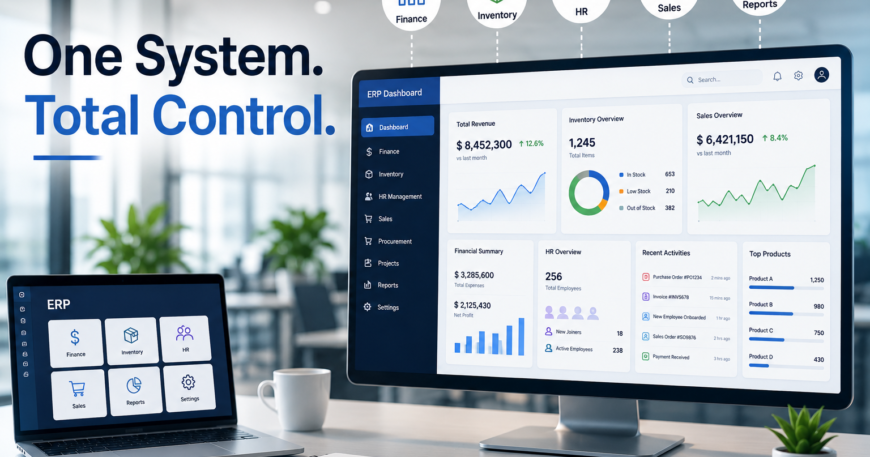
Enterprise Resource Planning (ERP) software integrates core business processes into a single platform.
Instead of operating through multiple disconnected systems, businesses can manage critical functions from one centralized environment.
Common ERP modules include:
- Finance & Accounting
- Inventory Management
- Procurement
- Human Resources
- Sales Management
- Customer Relationship Management
- Reporting & Analytics
A modern ERP system enables departments to share data seamlessly while improving operational efficiency.
The Challenges of Managing Multiple Systems
Many organizations rely on separate applications to manage different business functions.
This often results in:
- Duplicate data entry
- Inconsistent reporting
- Communication gaps
- Delayed decision-making
- Higher operational costs
As the business grows, these challenges become increasingly difficult to manage.
ERP solutions address these issues by creating a single source of truth across the organization.
How ERP Systems Improve Business Performance
Centralized Data Management
ERP systems consolidate information from multiple departments into a unified platform.
This provides better visibility and improves collaboration across teams.
Improved Operational Efficiency
Automation reduces repetitive tasks and eliminates unnecessary manual processes.
Employees spend less time managing data and more time focusing on strategic activities.
Better Decision Making
Real-time dashboards and reporting tools provide business leaders with accurate insights.
Organizations can make faster and more informed decisions.
Enhanced Scalability
ERP platforms are designed to support growing businesses.
As operations expand, businesses can add new modules and capabilities without disrupting existing processes.
Why Custom ERP Development Is Gaining Popularity
Many businesses discover that off-the-shelf ERP solutions do not fully align with their workflows.
Custom ERP development provides:
- Industry-specific functionality
- Flexible workflows
- Better integration capabilities
- Improved user adoption
- Greater scalability
Rather than adapting operations to fit software limitations, businesses can create ERP systems tailored to their exact requirements.
Industries Benefiting from ERP Solutions
Manufacturing
Improves production planning, inventory control, and supply chain visibility.
Retail
Enhances inventory management and sales reporting.
Healthcare
Supports patient management, resource planning, and compliance requirements.
Logistics
Optimizes fleet operations, shipment tracking, and warehouse management.
Professional Services
Improves project management, resource allocation, and financial tracking.
ERP Trends Shaping 2026
AI-Powered Analytics
ERP platforms are increasingly leveraging artificial intelligence to generate predictive insights.
Cloud-Based ERP
Businesses are adopting cloud ERP systems for greater flexibility and accessibility.
Mobile ERP Access
Teams can access business information from anywhere through mobile applications.
Workflow Automation
Organizations are automating approvals, reporting, and routine business processes.
Real-Time Business Intelligence
Modern ERP systems provide live dashboards that support faster decision-making.
Common ERP Implementation Mistakes
Successful ERP projects require careful planning.
Common mistakes include:
- Poor requirement analysis
- Insufficient employee training
- Lack of process optimization
- Choosing overly complex solutions
- Ignoring future scalability needs
Businesses that invest in proper planning achieve significantly better outcomes.
Real-World Example
Consider a growing manufacturing company using separate systems for procurement, inventory, accounting, and production planning.
Employees spend hours reconciling data between platforms, resulting in delays and reporting inconsistencies.
After implementing a custom ERP system, all departments operate within a centralized environment.
Inventory updates automatically, financial reports become accurate, and leadership gains real-time visibility into operations.
The result is improved productivity, better decision-making, and stronger business performance.
How ThinkDebug Helps
ThinkDebug develops custom ERP solutions designed around your business requirements.
Our ERP services include:
- ERP Consulting
- Custom ERP Development
- ERP Modernization
- Third-Party Integrations
- Workflow Automation
- Cloud ERP Solutions
- ERP Support & Maintenance
We help businesses build scalable systems that improve efficiency, visibility, and growth.
Conclusion
ERP systems have become essential for businesses seeking operational excellence.
By centralizing processes, improving visibility, and enabling data-driven decisions, ERP solutions help organizations operate more efficiently and scale with confidence.
In 2026, businesses that invest in ERP development are building the foundation needed for sustainable long-term growth

