


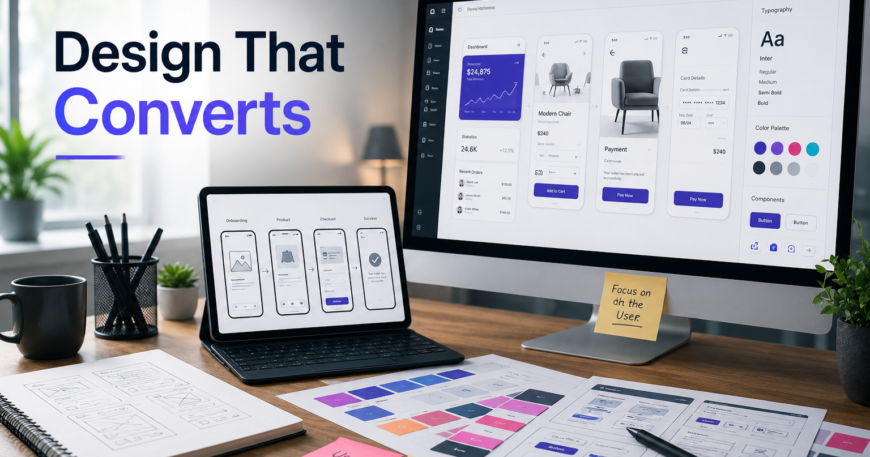
How UI/UX Design Impacts Business Growth More Than Most Companies Realize
Many businesses invest heavily in marketing, advertising, and technology but overlook one of the most influential factors affecting customer behavior: user experience.
A website or application may offer excellent products and services, but if users struggle to navigate, find information, or complete actions, the business will lose potential customers.
In 2026, UI/UX design is no longer just about aesthetics. It directly influences customer trust, engagement, conversion rates, and long-term business growth.
The most successful digital products are not necessarily those with the most features. They are the ones that make complex interactions feel simple.
Understanding UI and UX
Although often used together, UI and UX serve different purposes.
User Interface (UI)
UI focuses on the visual elements users interact with, including:
- Layouts
- Buttons
- Typography
- Colors
- Navigation elements
- Interactive components
User Experience (UX)
UX focuses on how users feel while interacting with a product.
It involves:
- Ease of use
- Accessibility
- Navigation flow
- Task completion
- User satisfaction
Together, UI and UX determine whether users enjoy interacting with a digital product or abandon it.
The Cost of Poor User Experience
Many businesses underestimate how much poor design impacts revenue.
Common problems include:
- Confusing navigation
- Slow user journeys
- Poor mobile experiences
- Excessive form fields
- Inconsistent interfaces
- Difficult checkout processes
These issues create friction.
Every extra step increases the likelihood that users leave before converting.
Research consistently shows that improving user experience can significantly increase engagement and conversion rates.
Why Great Design Drives Business Results
Businesses often view design as a creative investment.
In reality, it is a business investment.
Increased Conversion Rates
When users can easily find information and complete actions, conversion rates improve.
Whether the goal is generating leads, making sales, or booking appointments, simplicity often outperforms complexity.
Improved Customer Trust
First impressions happen quickly.
Professional and intuitive interfaces create confidence and credibility.
Customers are more likely to engage with businesses that appear modern, trustworthy, and easy to use.
Higher Customer Retention
Users tend to return to platforms that offer positive experiences.
Strong UX design increases loyalty by reducing frustration and improving satisfaction.
Reduced Support Costs
When interfaces are intuitive, customers require less assistance.
This reduces support requests and operational costs.
Why Mobile-First Design Is Essential
Most digital interactions now occur on mobile devices.
Businesses that continue designing primarily for desktop experiences risk alienating a significant portion of their audience.
Modern UI/UX strategies prioritize:
- Responsive layouts
- Touch-friendly interactions
- Fast loading speeds
- Mobile accessibility
- Streamlined navigation
A mobile-first approach ensures a consistent experience across devices.
UI/UX Trends Shaping 2026
The design landscape continues to evolve.
Several trends are influencing modern digital experiences.
AI-Powered Personalization
Interfaces are becoming increasingly adaptive to individual user preferences.
Micro-Interactions
Small animations and visual feedback enhance engagement and usability.
Accessibility-First Design
Businesses are prioritizing inclusive experiences for all users.
Minimalist Interfaces
Simpler designs are helping users focus on what matters most.
Data-Driven Design Decisions
Organizations are using analytics and user behavior insights to improve experiences continuously.
Real-World Example
Consider two businesses offering similar services.
One has a cluttered website with confusing navigation and slow loading pages.
The other provides a clean interface, clear messaging, and a simple customer journey.
Even if both offer identical services, customers are more likely to trust and engage with the business that provides a superior experience.
This demonstrates why design has become a competitive differentiator.
How ThinkDebug Helps
ThinkDebug creates user-focused digital experiences that balance aesthetics, functionality, and business objectives.
Our UI/UX services include:
- Website UI/UX Design
- Mobile App Design
- User Research
- Wireframing & Prototyping
- Design Systems
- Usability Testing
- Conversion Optimization
We help businesses build experiences that users enjoy while supporting measurable growth.
Conclusion
Great design is not about making products look attractive.
It is about helping users achieve their goals quickly and effortlessly.
Businesses that prioritize UI/UX design in 2026 will be better positioned to increase conversions, improve customer satisfaction, strengthen brand perception, and maintain a competitive advantage

