


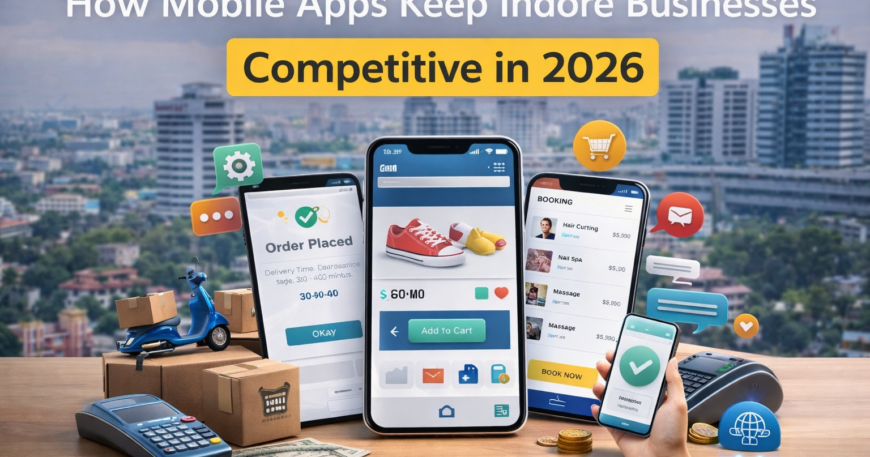
If you look at how people interact with businesses today, most of it happens on a phone.
Browsing products.
Booking services.
Tracking orders.
Talking to support.
For many businesses in Indore, this shift has been gradual. But in 2026, it’s very clear. Customers expect things to be quick, simple, and available in their hand.
That’s where mobile apps start to make a real difference.
A mobile app changes how customers engage with your business
A website works. But an app feels closer.
When someone installs your app, your business becomes part of their daily routine. It’s not something they need to search for again and again.
They just open it.
That small shift changes behavior:
- Faster access
- More frequent interaction
- Higher chances of repeat use
Over time, this leads to stronger customer relationships.
Speed and convenience drive usage
Most users don’t have patience for slow experiences.
If a website takes time to load or feels difficult to navigate, they leave. Apps remove that friction.
Everything is faster:
- Opening the app
- Browsing products or services
- Completing actions
When things feel smooth, people use it more often.
Apps help businesses stay visible
One of the biggest advantages of a mobile app is simple.
You stay in front of the customer.
Every time they unlock their phone, your app icon is there.
Push notifications also play a role:
- Order updates
- Offers
- Reminders
Used properly, they bring users back without being intrusive.
Not every business needs a complex app
A common misconception is that apps need to be feature-heavy.
That’s not true.
Many successful apps are simple:
- Easy login
- Clear navigation
- Core features that solve one problem well
Overbuilding usually creates confusion.
The goal is not to add features. The goal is to make things easier for users.
Indore businesses are starting to adopt apps more seriously
Earlier, apps were mostly used by large companies.
Now, even small and mid-sized businesses in Indore are exploring mobile apps.
Why?
Because customer behavior has changed.
People are comfortable using apps for:
- Ordering food
- Shopping
- Booking services
- Managing subscriptions
Businesses that adapt to this behavior stay relevant.
Internal apps improve operations too
Mobile apps are not only for customers.
Many businesses are now building apps for internal use:
- Managing teams
- Tracking tasks
- Monitoring inventory
- Handling field operations
This reduces manual work and improves coordination.
In many cases, internal apps bring just as much value as customer-facing ones.
Performance matters more than design alone
A good-looking app is useful, but performance matters more.
If the app:
- Crashes
- Lags
- Feels inconsistent
Users uninstall it quickly.
A stable, smooth app with simple design performs better than a complex but unreliable one.
Apps support long-term growth
A mobile app is not just a short-term feature.
It becomes part of your business system.
It helps:
- Build repeat usage
- Improve customer retention
- Create direct communication channels
- Reduce dependence on third-party platforms
Over time, this gives businesses more control.
Final thoughts
In 2026, mobile apps are no longer limited to large companies.
They are becoming a practical tool for businesses that want to stay competitive.
For Indore businesses, the shift is already visible.
Customers expect convenience.
They expect speed.
They expect everything to work smoothly.
A well-built mobile app helps meet those expectations.
At ThinkDebug, the focus is always on building apps that are simple, reliable, and actually useful in day-to-day business.
If you’re thinking about building an app, it’s worth starting with one question:
What problem are you trying to solve for your users?
That answer usually shapes everything else.
