

01
On-sale is ninety seconds of everything
A stadium of demand arrives at once against finite inventory. Nothing else in the product is tested like it.
Practical deep dives on software architecture, AI systems, and scaling digital products - drawn from the work we ship.
Ticketing, access control and event apps that survive an on-sale spike.
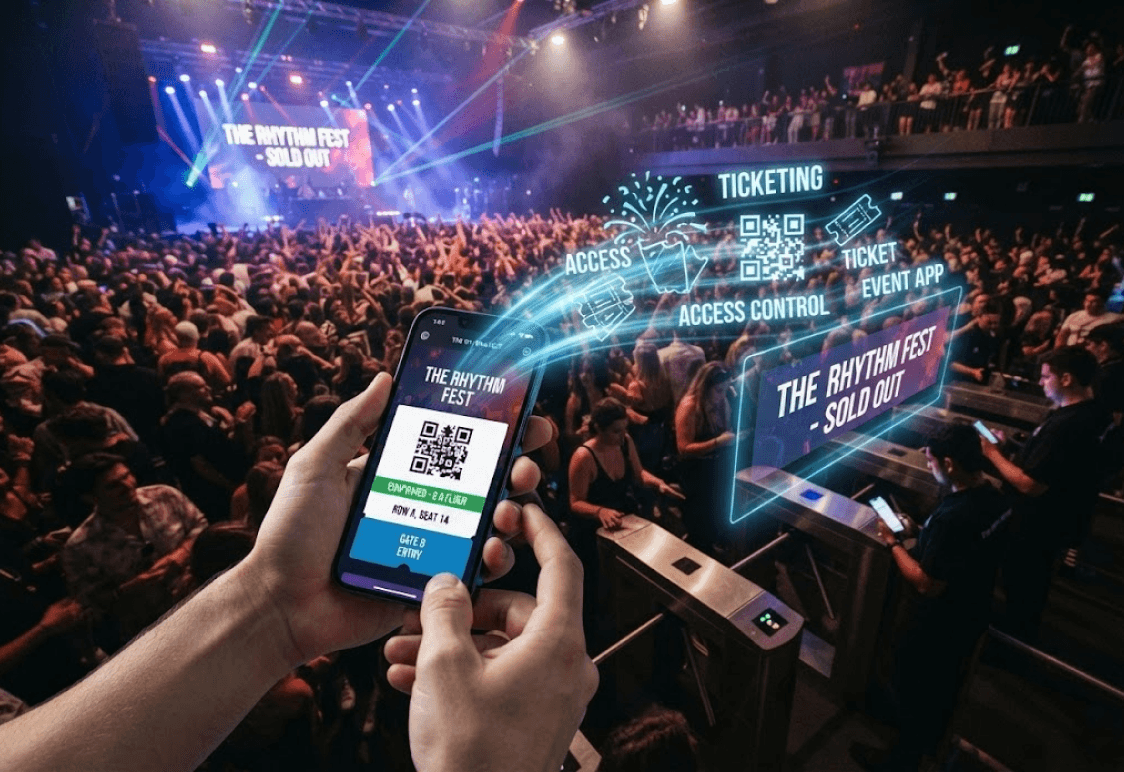
We build ticketing and event software: on-sale and checkout, seat and inventory management, access control at the gate, and the attendee apps and organiser tooling around them.
Ticketing is defined by one moment. An on-sale concentrates a stadium's worth of demand into ninety seconds, against inventory where two people must never get the same seat. Almost every architectural decision exists to survive that, and nothing else in the product is as unforgiving.
Then comes the gate. Thousands of scans in an hour, in a venue where the wi-fi is poor and the queue is real, which means access control has to work offline and still prevent the same ticket entering twice.
The constraints that shape every build in this sector, and the ones teams usually meet too late.
A stadium of demand arrives at once against finite inventory. Nothing else in the product is tested like it.
Inventory has to be strictly held and released, under exactly the load that makes races most likely.
Gate scanning has to work offline and still stop a ticket being used twice.
Bots, resale and duplicated tickets are an adversarial problem, not an edge case.
A slow scanner does not show a spinner, it creates a line outside a venue with a start time.
A cancellation or postponement means thousands of refunds at once, with fees and partial entitlements to resolve.
Swipe to read all 6
Each one is a system we have built before, not a capability we are willing to try.
Queueing, seat holds and checkout designed for the ninety seconds that matter.
Seat maps, holds, releases and allocations with strict correctness under load.
Offline-capable gate scanning with duplicate prevention that reconciles later.
Tickets, transfers and event information that work in a crowded venue.
Bot mitigation, controlled resale and ticket authenticity.
Payments, mass refunds and settlement to promoters and venues.
Engagements across sectors - the same team, the same standards.
Partnering with Thinkdebug to develop the Forever 52 mobile app has been a game-changer for us. They were always open to feedback, and it was clear they were as invested in our success as we were. What really sets them apart, though, is the amazing support we've received since the app launched. They’ve made sure the app continues to run smoothly and are always ready to fix any issues that come up.DMDhruv MehtaBusiness Head, Forever 52
Chosen for fit and long-term maintainability, never for novelty.
Send us the scope and we come back with an itemised estimate - no discovery fee, no obligation.
What we design and document against, from the first commit rather than the week before an audit.
Certification itself belongs to your entity and its assessor. What we provide is software built and documented so the assessment is about evidence rather than remediation.
Most of our work comes from clients we already shipped for. These are the reasons they give.
Queueing, warm capacity and a rehearsed run-through, because the on-sale is the only test that matters.
Inventory uses explicit holds with expiry, so the correctness guarantee survives the moment load makes races likely.
Scanners hold local state and reconcile, so a poor venue network never becomes a queue outside the door.
Bot mitigation and ticket authenticity are designed in, since resale pressure appears the moment an event sells out.
A cancellation is thousands of refunds with fees and partial entitlements, so it is built as a process rather than a support scramble.
Scan latency is treated as a venue operations metric, not a technical one.
Let's start with you.
Your information stays private. We reply within 24 hours.
Still have a question we have not answered?
Ask an engineerWhat we build for events & ticketing, the work we have shipped, and what we have written about it.


