
Most businesses use more than one software system.
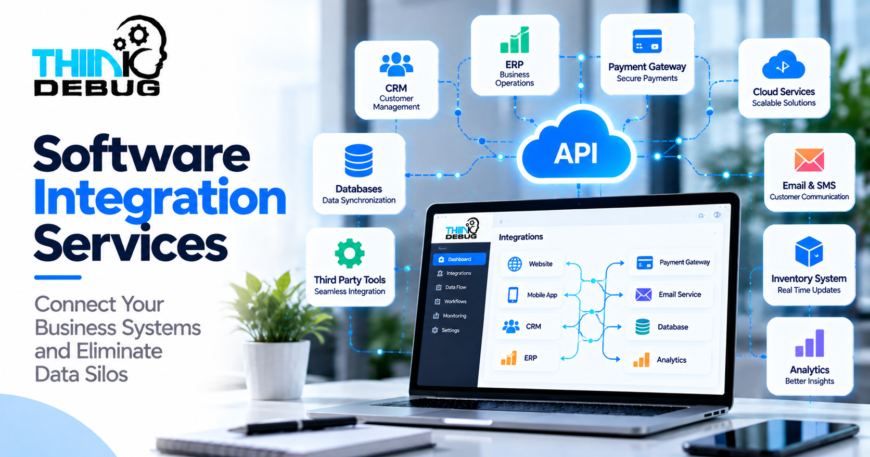
A company may have a website, CRM, accounting software, payment gateway, ERP, email platform, inventory system, mobile application, and several cloud services.
The problem begins when these systems don’t communicate with each other.
Employees may have to copy information from one application into another. Customers may need to provide the same information multiple times. Reports may require manually combining data from different systems.
This creates data silos, repetitive work, delays, and opportunities for errors.
Software integration solves this problem by allowing different applications and platforms to exchange information and work together.
ThinkDebug provides software integration services covering API development, third-party tools, cloud services, database synchronization, payment gateways, and CRM/ERP integrations.
What Is Software Integration?
Software integration is the process of connecting different applications, platforms, databases, or services so they can exchange data and perform coordinated actions.
For example:
Website → CRM → Sales Team
or:
Online Store → Payment Gateway → Order System → Customer Notification
Instead of employees manually transferring information, connected systems can automatically pass the required data between them.
The result is a more unified technology environment.
Why Businesses Need Software Integration
Disconnected software creates unnecessary manual work.
Imagine a customer places an order online.
Without integration, an employee may need to:
- Check the website.
- Copy customer information.
- Enter the order into the internal system.
- Verify the payment separately.
- Update inventory.
- Send a confirmation email.
With appropriate integrations, much of this workflow can happen automatically:
Order → Payment Verification → Inventory Update → CRM Update → Customer Notification
This can save time and make business processes more consistent.
1. API Integration
APIs are one of the most common ways applications communicate.
An API can allow one application to request information from another or send information to it.
Businesses commonly integrate APIs for:
- Payments
- Maps
- Shipping
- SMS
- Authentication
- Accounting
- CRM
- ERP
- Analytics
- Cloud services
A well-designed API integration can connect external services to the company’s existing software without requiring employees to manually transfer information.
2. CRM and ERP Integration
CRM and ERP systems often contain critical business information.
The CRM may contain customer and sales information, while the ERP manages areas such as inventory, finance, purchasing, or operations.
If these systems operate independently, employees may need to enter the same information multiple times.
Integration can create a connected workflow.
For example:
New Customer → CRM → ERP → Invoice → Customer Notification
This helps different departments work with more consistent information.
ThinkDebug specifically provides CRM and ERP system integration as part of its software integration services.
3. Payment Gateway Integration
Online businesses need reliable communication between their applications and payment providers.
A typical payment flow may involve:
Customer → Checkout → Payment Gateway → Payment Confirmation → Order System
The application needs to correctly handle successful payments, failed transactions, refunds, cancellations, and payment status updates.
A properly implemented integration can automatically update the order or account once the payment provider confirms the transaction.
This reduces manual verification and creates a smoother customer experience.
4. Database Synchronization
Businesses sometimes have information distributed across multiple databases.
For example:
- Customer database
- Product database
- Order database
- CRM database
- Analytics database
If the systems don’t synchronize correctly, different departments may see different information.
Database synchronization can help keep important information consistent across connected systems.
It is particularly useful when multiple applications need access to shared business data.
5. Cloud Service Integration
Modern businesses frequently use multiple cloud services.
A business application might communicate with cloud storage, email services, analytics platforms, authentication systems, databases, and other hosted services.
Integration allows these services to work together instead of operating as isolated tools.
For example:
Web Application → Cloud Storage → Database → Analytics
This can simplify operations while giving businesses access to the capabilities of specialized cloud platforms.
6. Automating Business Workflows
Integration becomes especially valuable when it triggers automated workflows.
Consider a support request submitted through a website.
Instead of an employee manually creating a ticket, the system could automatically:
Receive Request → Create Ticket → Assign Team → Send Notification → Update CRM
Similarly, a new customer registration could trigger:
Registration → CRM Entry → Welcome Email → Account Creation → Sales Notification
The integration isn’t simply moving data.
It is helping the business execute a process automatically.
7. Connecting Mobile Applications With Backend Systems
Mobile applications often depend on several backend services.
A mobile application may need to communicate with:
- User databases
- Payment systems
- Notification services
- Maps
- Booking platforms
- Analytics
- CRM systems
A properly designed API layer allows the mobile application to communicate with these services securely and reliably.
This becomes particularly important for applications where customers expect real-time information.
Benefits of Software Integration
A well-planned integration strategy can provide several business benefits.
Reduced Manual Work
Employees spend less time copying information between systems.
Better Data Consistency
Connected systems can work with synchronized information.
Faster Processes
Automated data exchange reduces unnecessary delays.
Fewer Manual Errors
Removing repetitive data entry can reduce common human errors.
Better Customer Experience
Customers can receive faster updates and smoother interactions.
Improved Visibility
Management can access information from multiple systems through connected dashboards and reporting platforms.
What Makes Integration Difficult?
Integration isn’t always as simple as connecting two applications.
Different systems may use different:
- Data formats
- Authentication methods
- APIs
- Database structures
- Business rules
- Update schedules
There can also be challenges around security, error handling, duplicate records, API limits, and unreliable third-party services.
This is why integration needs to be planned around the complete workflow rather than treated as a simple technical connection.
Secure Integration Matters
Business systems often exchange sensitive information.
An integration may handle customer details, payment information, financial data, employee records, or other confidential information.
Security considerations can include:
- API authentication
- Authorization
- Encryption
- Secure credentials
- Input validation
- Access control
- Logging
- Error handling
- Monitoring
Integration should therefore be designed with security from the beginning.
How ThinkDebug Approaches Software Integration
ThinkDebug’s software integration services are designed to connect applications, platforms, and databases into a unified digital environment. Its offering includes API development and integration, third-party tool integration, cloud service integration, database synchronization, payment gateway integration, and CRM/ERP integration.
The process can begin by understanding how information currently moves through the business.
From there, the integration architecture can be designed around the required systems, data, workflows, security requirements, and expected future growth.
Build a Connected Digital Business
Your business shouldn’t have to operate as a collection of disconnected software systems.
When your applications communicate properly, information can move where it is needed, repetitive processes can be automated, and employees can spend less time transferring data manually.
Whether you need API integration, CRM and ERP integration, payment gateway integration, database synchronization, cloud integration, or a complete connected software ecosystem, the right integration strategy can make your technology work together more effectively.
Have multiple systems that don’t communicate with each other? Talk to ThinkDebug about creating a connected and automated technology environment for your business.
