Technology can help a business grow, but only when it is aligned with the way the business actually operates.
Many companies invest in websites, software, cloud platforms, automation, CRM systems, mobile applications, and digital tools without first creating a clear technology strategy. The result can be disconnected systems, unnecessary expenses, inefficient workflows, and technology that becomes difficult to scale.
This is where business consultation services can make a difference.
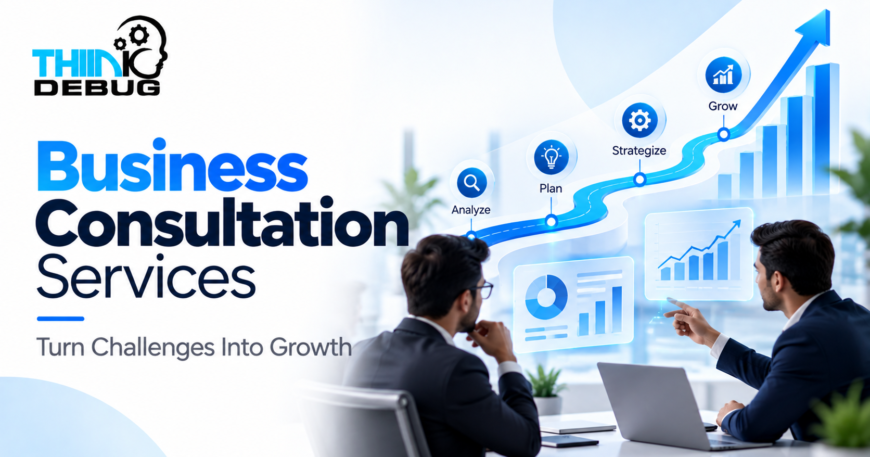
Business and IT consultation helps organizations understand their current technology environment, identify operational problems, evaluate opportunities, and create a practical roadmap for improvement.
ThinkDebug provides business consultation services focused on IT strategy, workflow optimization, technology integration, modernization, risk management, compliance, continuous support, and business scaling.
What Are Business Consultation Services?
Business consultation services help organizations make better decisions about their processes, technology, and digital operations.
For technology-driven businesses, consultation can cover areas such as:
- IT strategy
- Digital transformation
- Workflow optimization
- Software selection
- Technology modernization
- System integration
- Cloud adoption
- Process automation
- Risk management
- Compliance planning
- Technology roadmaps
- Scalability planning
- Ongoing IT support
The objective is not simply to recommend technology.
The objective is to understand the business problem first and then determine whether technology is the right solution.
Why Businesses Need Technology Consulting
As companies grow, their technology environment often becomes complicated.
A business might use one system for accounting, another for customer management, another for inventory, separate spreadsheets for operations, and several disconnected tools for communication and reporting.
Initially, this may work.
Eventually, however, businesses can experience:
- Duplicate data entry
- Manual processes
- Poor visibility
- Data inconsistencies
- Increasing operational costs
- Difficult reporting
- Integration problems
- Security concerns
- Slow decision-making
A technology consultant can examine the overall environment and identify where improvements can create the greatest business impact.
IT Strategy and Consulting
Technology investments should support business objectives.
For example, a company planning international expansion may need to think about:
- Infrastructure scalability
- Data security
- Multi-region availability
- Payment systems
- Localization
- Customer support
- Reporting
- Compliance
- Integration
A company trying to reduce operational costs may instead need:
- Workflow automation
- System integration
- Process redesign
- Better reporting
- Cloud optimization
- Centralized data
A technology strategy connects these business objectives with a practical implementation roadmap.
ThinkDebug specifically offers IT strategy and consulting to help businesses align technology initiatives with operational priorities, innovation, and long-term growth.
Business Process and Workflow Optimization
Technology cannot fix a process that has never been properly designed.
Before automating a workflow, businesses should understand how the process currently works.
A consultation can examine:
Current Process → Bottleneck → Root Cause → Improvement → Automation
For example, consider a sales process where employees manually transfer leads between spreadsheets, email, CRM software, and accounting systems.
Instead of simply adding another tool, a consultant can map the entire workflow and determine where automation or integration makes sense.
Potential improvements may include:
- Automated lead assignment
- CRM integration
- Automated notifications
- Approval workflows
- Document generation
- Payment integration
- Reporting dashboards
- Centralized customer records
The result is a technology solution based on the actual business process.
Digital Transformation Consulting
Digital transformation is not simply moving existing processes online.
It involves rethinking how technology can improve the way an organization operates.
A digital transformation roadmap might involve:
- Assessing the current technology environment
- Identifying operational problems
- Defining business objectives
- Prioritizing transformation opportunities
- Selecting appropriate technologies
- Designing the target architecture
- Creating implementation phases
- Measuring results
The transformation should be practical and measurable rather than driven purely by technology trends.
Technology Integration Consulting
Businesses frequently operate multiple applications that need to communicate.
For example:
Website → CRM → ERP → Payment Gateway → Accounting → Analytics
If these systems do not communicate effectively, employees may need to manually transfer information between platforms.
Integration consulting helps identify:
- Which systems should communicate
- What data needs to be exchanged
- How frequently information should synchronize
- Which APIs are available
- Where automation can be introduced
- How security should be managed
ThinkDebug provides technology integration and modernization consulting, including cloud adoption and connecting modern systems with existing infrastructure.
Legacy System Modernization
Older software can become a serious business limitation.
A legacy application may still perform an important function but have problems such as:
- Outdated technology
- Difficult maintenance
- Limited integrations
- Poor scalability
- Security concerns
- Lack of skilled developers
- Slow performance
Replacing it completely may not always be practical.
A modernization strategy can identify which components should be retained, upgraded, replaced, or integrated.
A typical modernization roadmap may include:
Assessment → Architecture → Data Migration → Module Modernization → Integration → Testing → Deployment
ThinkDebug also provides legacy system modernization as part of its software development capabilities.
Cloud Consulting
Cloud adoption can provide businesses with flexibility, but moving systems to the cloud without proper planning can create unnecessary complexity or costs.
Cloud consulting can evaluate:
- Current infrastructure
- Application architecture
- Database requirements
- Security
- Backup strategy
- Disaster recovery
- Scalability
- Monitoring
- Cloud costs
- Deployment strategy
The goal should not be to move everything to the cloud simply because cloud technology is popular.
The goal should be to determine where cloud infrastructure creates measurable value.
Software Selection Consulting
Choosing business software can be difficult.
Companies may evaluate dozens of CRM, ERP, HRMS, accounting, project management, or communication platforms.
A consultant can help evaluate options based on:
- Business requirements
- Features
- Integration capabilities
- Scalability
- Security
- Total cost
- Customization
- Vendor dependency
- Implementation complexity
- Long-term support
This helps businesses avoid choosing software simply because it has the longest feature list.
Custom Software vs Off The Shelf Software
One of the most common technology decisions businesses face is whether to buy existing software or build a custom solution.
Off The Shelf Software
Can be appropriate when:
- Requirements are standard
- Fast implementation is important
- Customization needs are limited
- Existing software already solves the problem
Custom Software
Can be appropriate when:
- Processes are highly specialized
- Existing software creates operational limitations
- Multiple systems need to be connected
- The business requires unique workflows
- The software itself is part of the competitive strategy
The decision should be based on business requirements, total cost, scalability, maintenance, and long-term objectives.
ThinkDebug provides both business consultation and custom software development, allowing these options to be evaluated within a broader technology strategy.
AI and Automation Consulting
AI is becoming part of many business strategies, but implementing AI without a clear use case can waste resources.
A consultation can identify processes where AI or automation could potentially create value.
Examples include:
- Customer support automation
- Document processing
- Data extraction
- Lead qualification
- Recommendation systems
- Internal knowledge assistants
- Workflow automation
- Predictive analytics
- Content operations
The important question is not:
“Where can we add AI?”
It is:
“Which business problem can AI solve better, faster, or more efficiently?”
This distinction helps businesses focus AI investments on practical outcomes.
Risk Management and Compliance
Technology decisions can introduce operational and security risks.
Businesses may need to consider:
- Data protection
- Access control
- Backup
- Disaster recovery
- Third-party dependencies
- Infrastructure security
- Application vulnerabilities
- Compliance requirements
- Business continuity
A consultation can help identify potential risks and establish strategies to reduce them.
ThinkDebug lists risk management and compliance among its business consultation capabilities, including proactive safeguards and strategies designed to protect business operations.
Technology Roadmaps
One of the most useful outputs of a consulting engagement is a technology roadmap.
Instead of trying to implement everything simultaneously, businesses can prioritize initiatives.
A roadmap might look like:
Phase 1 — Foundation
- Infrastructure assessment
- Security improvements
- Data cleanup
- System documentation
Phase 2 — Optimization
- Workflow automation
- System integrations
- Reporting
- Performance improvements
Phase 3 — Transformation
- New applications
- AI capabilities
- Cloud modernization
- Advanced analytics
Phase 4 — Scale
- Infrastructure expansion
- Automation
- New markets
- Additional integrations
This approach allows businesses to control investment while progressing toward a larger technology vision.
Business Consultation for Startups
Startups often have limited resources and cannot afford expensive technology mistakes.
Early-stage consulting can help founders determine:
- What should be built
- What should be purchased
- What belongs in the MVP
- Which technologies are appropriate
- How the architecture should scale
- Which integrations are essential
- What should be postponed
A practical technology strategy can prevent startups from overengineering their first product.
The focus should be on building enough technology to validate the business while leaving a clear path for future growth.
Business Consultation for Established Companies
Established businesses often face a different challenge.
They may already have multiple systems, teams, vendors, databases, and processes.
Consulting can help create a more unified technology strategy.
This may involve:
- Technology audits
- Architecture reviews
- Process analysis
- Integration planning
- Legacy modernization
- Cloud migration
- Security assessments
- Automation
- Digital transformation
The goal is to improve the existing environment without unnecessarily disrupting daily operations.
Measuring Technology ROI
Technology investments should ultimately produce business value.
Depending on the project, useful measurements can include:
- Reduced processing time
- Lower operational costs
- Increased sales
- Higher conversion rates
- Reduced manual work
- Faster customer response
- Fewer errors
- Improved system availability
- Better reporting
- Increased employee productivity
A technology roadmap becomes much more useful when each major initiative has a clear reason for existing.
Why Choose ThinkDebug for Business Consultation?
Technology consulting is more effective when recommendations can be connected to actual implementation.
ThinkDebug works across software development, websites, mobile applications, UI/UX, APIs, cloud technologies, integrations, and digital solutions. Its service portfolio emphasizes client-centric solutions, agile delivery, full-cycle development, and long-term support.
This means a consulting engagement can move beyond a strategy document when implementation is required.
For example:
Business Problem → Consultation → Technology Roadmap → Development → Integration → Deployment → Support
That creates a more connected path between business planning and technology execution.
Final Thoughts
Technology should solve business problems, not create new ones.
Before investing in another software platform, rebuilding an application, migrating to the cloud, introducing AI, or automating a workflow, businesses should first understand what they are trying to improve.
Professional business consultation can help organizations make those decisions with greater clarity.
Whether you are a startup planning your first digital product, an established company modernizing legacy systems, or a growing organization trying to connect multiple platforms, the right technology strategy can create a stronger foundation for long-term growth.
Have a technology challenge but aren’t sure what solution you actually need?
ThinkDebug can help assess your current environment, identify opportunities, create a practical roadmap, and guide implementation.
Turn your technology challenges into a clear plan for business growth.
