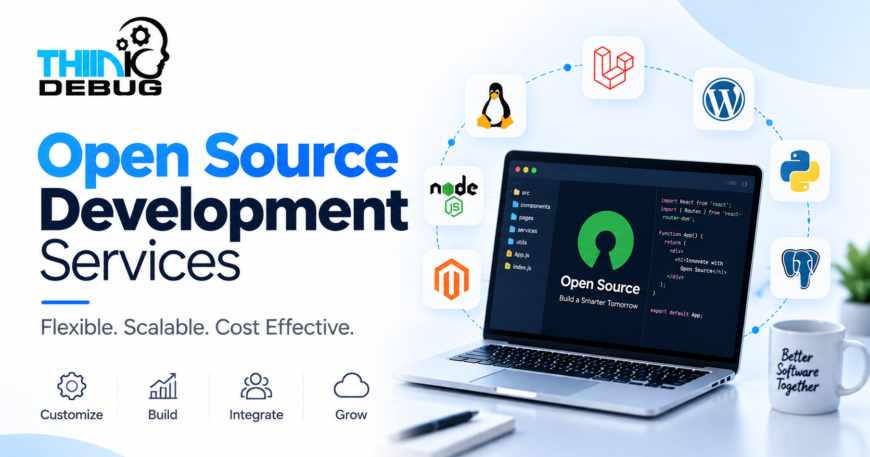
Modern businesses are under constant pressure to innovate faster while keeping technology costs under control. Organizations need software that can be customized, integrated with existing systems, and scaled as their operations grow.
Open source development provides businesses with a powerful way to achieve these goals.
Instead of building every component from scratch or depending entirely on proprietary platforms, businesses can leverage mature open source technologies and customize them around their specific requirements.
ThinkDebug provides open source development services focused on creating flexible, secure, scalable, and cost-effective software solutions aligned with business objectives. ThinkDebug’s official service portfolio specifically highlights open source development as a service for businesses looking for customizable and scalable solutions.
What Is Open Source Development?
Open source development involves using software whose source code is publicly available and can generally be inspected, modified, and extended according to its licensing terms.
Popular open source technologies power a large portion of today’s digital infrastructure, including:
- Web applications
- Mobile applications
- Databases
- Content management systems
- Cloud platforms
- Development frameworks
- Business applications
- AI and machine learning systems
- DevOps infrastructure
- Enterprise software
Rather than treating open source simply as a way to reduce licensing costs, businesses can use it as a foundation for building highly customized technology solutions.
Why Businesses Choose Open Source Software
Traditional proprietary software can sometimes limit how much a business can customize a system.
Open source technologies can provide greater flexibility because development teams can modify or extend the underlying software where the license permits.
Some potential benefits include:
- Lower software licensing costs
- Greater customization
- Faster development
- Access to established technologies
- Reduced vendor dependency
- Easier integration
- Flexible architecture
- Community-supported ecosystems
- Greater control over deployments
- Long-term scalability
However, open source does not automatically mean free or maintenance-free. Proper architecture, security, development, upgrades, and support are still essential.
Custom Open Source Development
Every organization has different workflows and operational requirements.
Instead of adapting business processes to an existing platform, developers can customize open source technologies around the organization’s requirements.
Custom open source development can include:
- Business management applications
- Customer portals
- Internal enterprise systems
- SaaS platforms
- E-commerce solutions
- Content platforms
- Workflow automation
- Data management systems
- Custom dashboards
- API-based applications
ThinkDebug’s broader software development offering includes custom software, enterprise applications, integrations, modernization, and ongoing support.
Open Source Web Development
Open source technologies provide a strong foundation for modern websites and web applications.
Development teams can combine frameworks, libraries, databases, APIs, and infrastructure tools to create applications tailored to business requirements.
Depending on the project, an open source web solution can include:
- Responsive frontend interfaces
- Custom backend systems
- User authentication
- Admin dashboards
- Payment integration
- Third-party APIs
- Search functionality
- Reporting
- Notifications
- Cloud deployment
The technology selection should be based on application requirements rather than simply choosing the most popular framework.
Open Source CMS Development
Content management systems allow businesses to manage digital content without modifying application code every time a page needs to be updated.
Open source CMS platforms can be customized to support:
- Corporate websites
- News portals
- Educational platforms
- Publishing websites
- Membership platforms
- Community websites
- E-commerce websites
- Multi-language websites
Customization can range from theme and UI modifications to plugins, modules, integrations, and completely custom functionality.
Open Source E Commerce Development
Businesses launching online stores often need more flexibility than standard hosted platforms provide.
Open source e-commerce platforms can be customized for specific business models and workflows.
Development may include:
- Product management
- Categories
- Shopping carts
- Checkout
- Payment gateways
- Shipping integration
- Coupons
- Inventory management
- Customer accounts
- Order management
- Tax configuration
- Vendor management
- Reporting
Open source architecture can be particularly useful when a business requires functionality that is difficult to implement using a standard SaaS platform.
Open Source Enterprise Software
Large organizations often operate multiple systems across departments.
Open source development can be used to create or customize enterprise applications for:
- CRM
- ERP
- HR management
- Inventory
- Finance
- Document management
- Business intelligence
- Supply chain
- Workflow automation
ThinkDebug’s enterprise software capabilities include ERP, CRM, HRMS, business intelligence, document management, supply chain and logistics, and finance and accounting solutions.
The goal is to create a connected software environment where teams can access the information and workflows they need.
Open Source API Development
APIs are essential for connecting modern applications.
An organization may need to connect its software with:
- Payment gateways
- CRM systems
- ERP systems
- Mobile applications
- Cloud services
- Third-party platforms
- Analytics systems
- Communication services
- AI platforms
Open source frameworks can be used to create secure and scalable APIs that allow different systems to communicate.
ThinkDebug also provides API development and third-party integration as part of its software integration services.
Open Source Application Modernization
Many organizations continue to operate older applications that are expensive to maintain or difficult to extend.
Completely replacing such systems can be risky.
A modernization strategy can gradually transform the existing technology while reducing disruption.
A typical process can involve:
- Reviewing the existing application
- Identifying technical limitations
- Evaluating open source alternatives
- Designing the target architecture
- Migrating data
- Rebuilding priority modules
- Integrating existing systems
- Testing the modernized application
- Deploying gradually
- Providing ongoing support
ThinkDebug offers legacy system modernization involving application analysis, technology upgrades, re-engineering, data migration, cloud migration, and modern integrations.
Open Source Cloud Development
Open source technologies work well with modern cloud infrastructure.
Applications can be deployed across cloud environments such as AWS, Azure, and Google Cloud, depending on project requirements.
Cloud-based open source development can support:
- Scalable infrastructure
- Containerized applications
- Automated deployments
- Distributed systems
- Microservices
- Database clusters
- Monitoring
- Backup systems
- Load balancing
ThinkDebug’s software development technology stack includes cloud platforms such as AWS, Azure, and Google Cloud, along with Docker, microservices, Git, CI/CD, REST APIs, and GraphQL.
Open Source Security
Using open source software does not remove the need for security.
In fact, security needs to be considered throughout the entire development and maintenance lifecycle.
A secure open source application may require:
- Dependency monitoring
- Security patching
- Access control
- Authentication
- Authorization
- Input validation
- API protection
- Encryption where appropriate
- Vulnerability scanning
- Secure configuration
- Logging and monitoring
- Backup and recovery
The development team should also review the licenses and dependencies used in the project to ensure they are appropriate for the intended commercial or organizational use.
Open Source Integration Services
Many businesses already have multiple applications operating independently.
For example, an organization might use separate systems for:
CRM → ERP → Payment → Accounting → Analytics
Without proper integration, employees may have to manually move information between systems.
Open source development can be used to build integration layers that synchronize data and automate workflows.
ThinkDebug provides software integration services covering APIs, third-party tools, cloud services, databases, payment gateways, and CRM/ERP integrations.
Open Source Development for Startups
Startups often have limited budgets but need to move quickly.
Open source technologies can help startups avoid unnecessary licensing costs while providing access to mature development ecosystems.
A startup can use open source technologies to build:
- MVPs
- SaaS platforms
- Mobile backends
- Marketplaces
- E-commerce applications
- Customer portals
- Admin systems
- Internal automation tools
The architecture can then evolve as the business gains customers and investment.
The important point is to avoid building an unnecessarily complex architecture at the MVP stage while still leaving a clear path for future growth.
Open Source Development for Enterprises
Enterprises have different priorities.
They may require:
- High availability
- Security
- Scalability
- Integration
- Compliance
- Centralized management
- Monitoring
- Disaster recovery
- Long-term maintenance
Open source solutions can be incorporated into enterprise environments when their licensing, security, support, architecture, and operational requirements are properly evaluated.
Open Source Maintenance and Support
One of the biggest misconceptions about open source is that once software has been deployed, the work is finished.
Applications require continuous maintenance.
This can include:
- Security patches
- Dependency updates
- Bug fixes
- Performance optimization
- Database maintenance
- Infrastructure monitoring
- Feature development
- Compatibility updates
- Backup management
- Security audits
ThinkDebug provides software maintenance and support services covering updates, bug fixing, performance monitoring, security improvements, and feature upgrades.
Why Choose ThinkDebug for Open Source Development?
Open source development requires more than familiarity with frameworks and libraries.
The development team needs to understand:
- Business requirements
- Software architecture
- Security
- Integration
- Scalability
- Deployment
- Maintenance
- Licensing considerations
ThinkDebug follows a development process covering requirement analysis, strategic planning, UI/UX design, development, testing, deployment, and ongoing support.
The company also works across multiple frontend, backend, mobile, database, cloud, API, containerization, and CI/CD technologies, allowing open source components to be selected according to the requirements of each project.
The Future of Open Source Development
Open source continues to play an important role in modern software development.
From cloud infrastructure and databases to web frameworks, AI technologies, DevOps tools, and enterprise applications, businesses have access to an enormous ecosystem of reusable technology.
The real advantage comes from using that ecosystem intelligently.
Instead of reinventing every component, development teams can identify proven technologies, customize them where necessary, integrate them with existing systems, and build proprietary business functionality around them.
Final Thoughts
Open source development can give businesses greater control, flexibility, and customization while reducing dependence on proprietary platforms.
But successful open source development requires thoughtful technology selection, secure implementation, proper architecture, continuous maintenance, and a clear understanding of licensing requirements.
Whether you need a custom business application, e-commerce platform, SaaS product, enterprise system, API integration, or legacy modernization project, open source technologies can provide a strong foundation.
Looking to build a flexible and scalable software solution without unnecessary technology limitations?
ThinkDebug can help you evaluate the right open source technologies, build custom functionality, integrate your existing systems, and maintain the application as your business grows.
Talk to ThinkDebug today and turn your software requirements into a scalable digital solution.
