Why Businesses Are Investing in SaaS Product Development in 2026
Software as a Service (SaaS) has transformed how businesses consume and deliver technology. Instead of purchasing expensive software licenses and maintaining complex infrastructure, organizations can now access powerful applications through the cloud.
This shift has created enormous opportunities for startups and established businesses alike.
In 2026, SaaS products continue to dominate the software industry because they offer scalability, accessibility, recurring revenue opportunities, and faster innovation cycles.
Businesses that successfully launch SaaS products are not only solving customer problems but also creating sustainable digital revenue streams.
What Is SaaS Product Development?
SaaS product development involves designing, building, deploying, and maintaining software applications that users access through the internet.
Unlike traditional software, SaaS products:
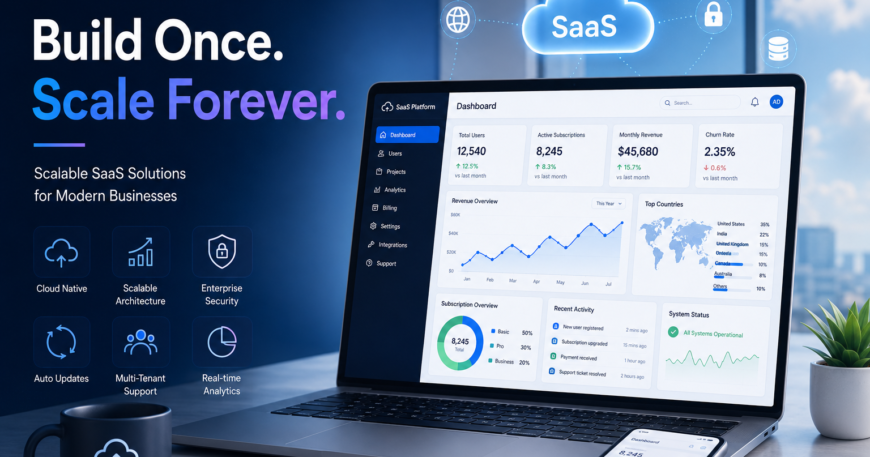
- Operate in the cloud
- Require no local installation
- Support subscription-based pricing
- Enable automatic updates
- Scale easily with user growth
Examples include CRM platforms, project management tools, learning management systems, HR software, and analytics platforms.
Why SaaS Is Growing Faster Than Traditional Software
Modern businesses demand flexibility.
Traditional software often requires:
- Large upfront investments
- Complex installations
- Hardware infrastructure
- Lengthy upgrade cycles
SaaS solutions eliminate these challenges by providing instant access and continuous improvements.
This makes SaaS attractive to businesses of all sizes.
Key Benefits of SaaS Product Development
Recurring Revenue Model
One of the biggest advantages of SaaS is predictable recurring revenue.
Subscription models provide consistent cash flow while supporting long-term customer relationships.
Global Accessibility
Users can access SaaS applications from anywhere with an internet connection.
This flexibility supports modern remote and hybrid work environments.
Scalability
Cloud-based architecture allows SaaS platforms to handle increasing users and workloads efficiently.
Businesses can grow without major infrastructure investments.
Faster Product Updates
New features and improvements can be deployed instantly without requiring users to install updates.
Improved Customer Insights
SaaS platforms generate valuable usage data that helps businesses improve products and customer experiences.
Real-World Example
Imagine a company offering project management software.
Instead of selling one-time software licenses, they launch a SaaS platform with monthly subscription plans.
Customers gain access through a web browser, receive regular feature updates, and scale usage as their teams grow.
The company benefits from recurring revenue while continuously improving the product based on customer feedback.
This model creates a win-win scenario for both provider and customer.
Industries Benefiting from SaaS Solutions
Healthcare
Patient management, telemedicine, and operational software.
Education
Online learning platforms and student management systems.
Finance
Accounting, reporting, and financial planning tools.
Human Resources
Recruitment, payroll, and employee management solutions.
Logistics
Fleet tracking, warehouse management, and supply chain visibility.
SaaS Trends Shaping 2026
AI-Powered SaaS
Artificial intelligence is becoming a standard feature in modern SaaS applications.
Vertical SaaS
Industry-specific SaaS platforms are gaining popularity due to specialized functionality.
Low-Code and No-Code Capabilities
Businesses are empowering users to customize workflows without extensive development.
Advanced Security
Organizations are prioritizing data privacy, compliance, and cybersecurity.
Hyper-Personalization
SaaS platforms are using customer data to deliver personalized experiences.
Common SaaS Development Mistakes
Businesses should avoid:
- Building too many features too early
- Ignoring user feedback
- Poor scalability planning
- Weak security implementation
- Lack of product-market fit validation
Successful SaaS products focus on solving specific problems exceptionally well.
How ThinkDebug Helps
ThinkDebug helps startups and enterprises build scalable SaaS products from concept to launch.
Our SaaS development services include:
- SaaS Product Consulting
- Product Architecture Design
- Multi-Tenant Application Development
- Cloud Infrastructure Setup
- API Development & Integration
- SaaS UI/UX Design
- Ongoing Product Maintenance
We help businesses transform innovative ideas into successful cloud-based products.
Conclusion
SaaS continues to redefine how software is built, delivered, and monetized.
Businesses investing in SaaS product development gain opportunities to create recurring revenue, serve global audiences, and build scalable digital products.
In 2026, SaaS is not simply a software delivery model. It is one of the most powerful business growth strategies available.

