

How Custom CRM Development Helps Businesses Build Stronger Customer Relationships
Customer relationships are one of the most valuable assets a business can have. Yet many organizations struggle to manage customer interactions effectively because their data is spread across spreadsheets, emails, messaging platforms, and multiple software systems.
As businesses grow, this fragmented approach creates inefficiencies that impact sales performance, customer satisfaction, and long-term growth.
In 2026, companies are increasingly investing in custom CRM development to centralize customer information, automate workflows, and create more personalized customer experiences.
A well-designed CRM system does more than store contact details. It becomes the foundation for stronger customer engagement and smarter business decisions.
What Is a CRM System?
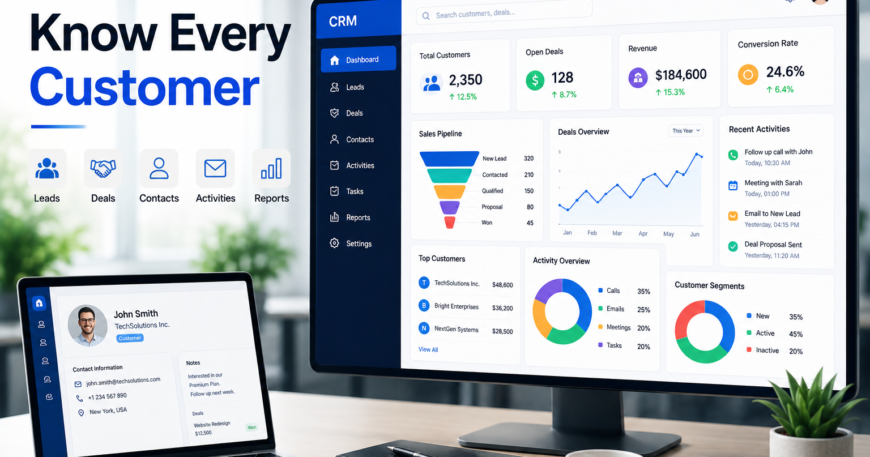
Customer Relationship Management (CRM) software helps businesses manage interactions with current and potential customers.
A CRM platform typically allows organizations to:
- Store customer information
- Track communication history
- Manage sales pipelines
- Monitor customer activities
- Automate follow-ups
- Generate business reports
By keeping all customer-related information in one place, businesses gain better visibility into relationships and opportunities.
Why Businesses Outgrow Generic CRM Solutions
Many organizations begin with off-the-shelf CRM software.
While these platforms provide useful features, they often come with limitations.
Common challenges include:
- Unnecessary features that complicate workflows
- Limited customization options
- Integration difficulties
- Scalability issues
- Higher licensing costs as teams grow
As operations become more complex, businesses often discover that generic CRM systems do not align with their unique processes.
This is where custom CRM development delivers significant value.
Benefits of Custom CRM Development
Tailored to Your Business Processes
Every organization manages customers differently.
A custom CRM is built around existing workflows rather than forcing teams to adapt to software limitations.
This improves productivity and user adoption.
Improved Sales Management
Custom CRM solutions help sales teams track leads, opportunities, and customer interactions more effectively.
This improves pipeline visibility and conversion rates.
Better Customer Experiences
With centralized customer information, businesses can deliver more personalized interactions and faster support.
Customers feel understood and valued.
Workflow Automation
Routine tasks such as follow-ups, reminders, lead assignments, and reporting can be automated.
This reduces administrative work and increases efficiency.
Scalable Growth
As businesses expand, custom CRM platforms can evolve alongside changing requirements without requiring complete system replacements.
Real-World Example
Imagine a growing real estate company managing leads through spreadsheets and multiple communication channels.
Agents struggle to track follow-ups, customer history, and deal progress.
After implementing a custom CRM system, all lead information, communications, and property inquiries become centralized.
Automated reminders ensure no opportunities are missed, and management gains real-time visibility into sales performance.
The result is higher productivity, improved customer engagement, and increased revenue.
Industries Benefiting from CRM Development
Real Estate
Manage leads, property inquiries, and customer communications.
Healthcare
Improve patient relationship management and appointment coordination.
Education
Track admissions, student interactions, and communication workflows.
Professional Services
Manage client relationships and project communications.
Retail and E-Commerce
Improve customer engagement and retention strategies.
CRM Development Trends in 2026
AI-Powered Customer Insights
Businesses are using artificial intelligence to predict customer behavior and identify sales opportunities.
CRM Automation
Organizations are automating repetitive processes to improve efficiency.
Mobile CRM Platforms
Sales teams increasingly rely on mobile access to customer information.
Advanced Analytics
Businesses are using CRM data to improve decision-making and customer retention.
Omnichannel Integration
Modern CRM systems connect websites, social media, email, messaging platforms, and support channels into a unified customer view.
Common CRM Implementation Mistakes
To maximize results, businesses should avoid:
- Poor requirement planning
- Overcomplicated workflows
- Insufficient user training
- Weak integration strategies
- Ignoring scalability needs
A successful CRM project starts with understanding business objectives and customer management challenges.
How ThinkDebug Helps
ThinkDebug develops custom CRM solutions tailored to specific business requirements.
Our CRM development services include:
- Custom CRM Development
- CRM Modernization
- Workflow Automation
- Third-Party Integrations
- Sales Pipeline Management
- Analytics & Reporting
- CRM Support & Maintenance
We help businesses create customer-centric systems that improve efficiency, engagement, and growth.
Conclusion
Customer expectations continue to rise, making relationship management more important than ever.
Businesses that invest in custom CRM development gain greater visibility, stronger customer relationships, improved productivity, and better growth opportunities.
In 2026, CRM is no longer just a sales tool. It is a strategic platform that supports long-term business success.

